






Mobile App Development Cost in India 2026: Rates, Timeline & Process


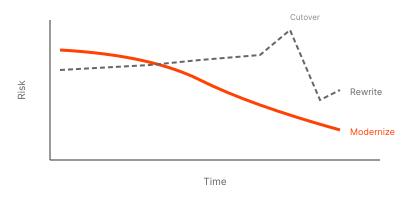

A risk reduction program. It improves security, reliability, compliance evidence, and delivery safety while the system stays live. It produces measurable outcomes early and reduces operational exposure continuously.

A product rebuild program. It replaces the system with a new codebase while the business still depends on legacy until cutover. Unknown integrations and edge cases are often discovered late, when change is expensive.
This is where programs often fail: a rewrite is treated as a faster modernization.

If the system supports revenue workflows, regulated data, or high-availability requirements, modernization is usually the safer first step ..
Modernization makes dependencies visible, reduces control gaps, and stabilizes change. After that, modules that require a clean break can be rebuilt with far less uncertainty.
A full rewrite is best reserved for systems that are isolated, clearly scoped, and capable of a controlled parallel run with reversible cutover.
Swipe to compare columns
| Decision factor | Modernize the legacy system | Rewrite from scratch |
|---|---|---|
| Time to first outcome | 2 to 8 weeks | 4 to 12 months |
| Downtime risk | Low when phased with rollback | Medium to high at cutover |
| Requirement stability | Moderate | High |
| Integration complexity | Reduced incrementally | Commonly underestimated |
| Compliance posture | Improved early | Often addressed late |
| Delivery risk | De-risks continuously | Uncertainty persists longer |
| Cost profile | Phased investment, earlier returns | High burn before outcomes |
| Team capacity | Focused team with SME support | Two-stack delivery load |
| Best fit | Regulated, complex, revenue-critical | Isolated, stable scope systems |

Modernization delivers measurable value early. Rewrites delay outcomes until final cutover.
Deliverable: PDF report, risk heatmap, phased roadmap
Product/process SME access, architecture owner, QA for high-risk journeys, Ops/SRE support
Dedicated product function, strong QA automation, parallel operations capacity, integration owners, explicit cutover programme
A rebuild can be justified when at least three of the following apply:
If these conditions do not hold, refactor and modularize first.
Prevention:Mine incidents, support tickets, and logs before rebuilding
Prevention:Build integration inventory and dependency map first
Prevention: Design reversible cutover, shadow traffic, and rollback early
Prevention:Use modernization to deliver incremental outcomes while learning
Prevention:Implement logging, access controls, and evidence capture early
Prevention: Phase work, reduce operational load, stabilise before expansion
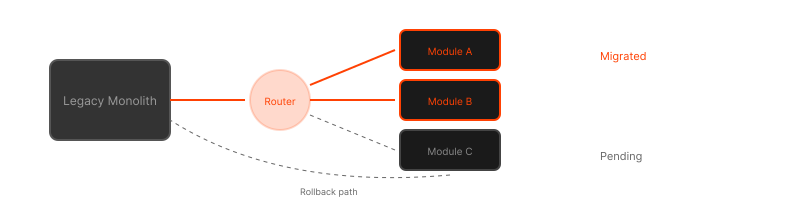
Stabilise production
Add observability
Release safety controls
Map dependencies
Incremental routing
Extract modules
Execution Evidence
See how we applied incremental modernization to real enterprise systems with documented outcomes.
| Module | Security | Compliance | Change Risk | Availability |
|---|---|---|---|---|
| Auth Service | High | Medium | Low | High |
| Payment Gateway | High | High | Medium | High |
| Reporting Module | Low | Medium | Low | Low |
| User Management | Medium | Low | Medium | Medium |

Evidence mapping across security, compliance, and availability

Rollback design built into every deployment

Before structural change, not during
Context: Multiple integrations, strict audit expectations, high uptime requirements..
Decision: Phased modernization first, with dependency mapping and release safety controls before module extraction.
Outcome:Reduced change failure, improved audit evidence readiness, safer incremental delivery.
Context: Sensitive data, logging gaps, undocumented flows, operational risk..
Decision: Stabilisation and compliance controls first, followed by selective refactor and modularisation.
Outcome: Improved traceability, fewer production incidents, clearer path for future rebuild..
A defensible decision addresses:
Modernization is frequently easier to govern because risk reduction becomes visible early and progress can be measured every 30 days.
You receive:
Still have questions about Legacy Modernization vs Rewrite? Check out our FAQs to better understand the differences between modernizing existing systems and rewriting from scratch including cost considerations, risks, timelines, and technical impact. If you don’t find what you’re looking for, feel free to reach out to us directly we’re happy to clarify your concerns.
Modernization continuously lowers risk while enhancing the current system. Everything is replaced with new code in a rewrite, which concentrates uncertainty into a single, high-risk cutover event. This is where unknown edge situations frequently arise when change is most costly.
Systems that are vital to revenue are safer when modernized. You start by stabilizing change, minimizing control gaps, and making dependencies obvious. Modules that require a fresh start can then be rebuilt with significantly reduced risk and uncertainty.
Within two to eight weeks, modernization produces initial results. It takes four to twelve months for rewrites to have any results. You consistently lower risk as you modernize. Uncertainty remains after rewriting until the last cutover.
Update when there are severe uptime requirements, incomplete documentation for integrations, a desire to increase compliance, or when you want results next quarter rather than next year. Only rewrite for isolated systems that can run in parallel and have a stable scope.
Only under three circumstances: requirements can be frozen, parallel running is possible, and the system is isolated with few integrations. Modernize first if you are unable to enumerate the most important production edge situations that keep your company operating.
Teams tend to overdesign for the “perfect system.” Delivery slows, architecture gets heavier, and scope increases. Rarely does the system you envision align with what production actually requires. Reality is shown by modernization before reconstruction is committed to.
Every stage of modernization lowers exposure, hence continuously de-risking. Rewrite focuses ambiguity into a lengthy delivery period. When modification is costly and rollback is painful, edge cases are discovered later.
Investments made during the modernization phase yield earlier returns. Rewriting is expensive before any results show up. Missed requirements, unexpected integrations, and team exhaustion from managing two stacks are examples of hidden rewriting costs.
That is the wise course of action. First, modernization stabilizes change and reveals dependencies. Modules that need clean breaks can therefore be constructed with far less ambiguity, and you can rank them according to business value.
Logging, access controls, and evidence collection are some of the ways that modernization enhances compliance early. Late compliance is addressed by rewrites, frequently after auditors have identified problems. Modernization is typically the safer first step for industries that are subject to regulations.