







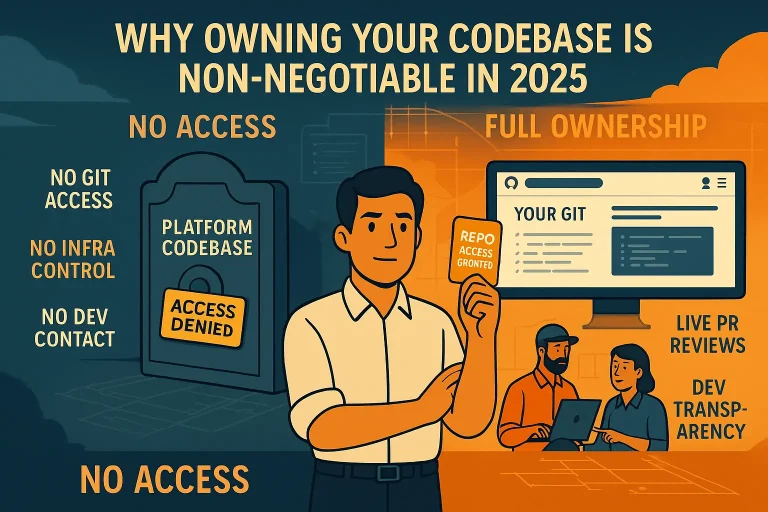
What “Code Ownership” Actually Means
Let’s define it clearly. You own your codebase when:
- You control the source code.
- You have admin rights to your repo (GitHub/GitLab/Bitbucket).
- You manage the infrastructure or deployment environment.
- You’re free to change, migrate, or pause development without asking permission.
If you don’t have those things, you don’t own your product. You’re renting it from your vendor.
Why Founders Overlook Ownership (Until It’s Too Late)
Platforms like Builder.ai made it easy to believe: “I don’t need to worry about tech, they handle it.”
But what’s easy in phase one becomes a trap in phase two:
- Want to switch vendors? You can’t.
- Want to pivot the tech stack? Too bad.
- Want to add your developers? Not allowed.
- Want to raise a round? You’ll need full technical due diligence, and you can’t provide it.
Ownership isn’t just about building. It’s about protecting value.
The Risks of Not Owning Your Code
Let’s be blunt, here’s what you lose when your vendor owns the code:
- Freedom: You can’t move or scale on your terms.
- Security: You’re at the mercy of platform uptime and internal decisions.
- Visibility: You don’t know what’s happening until it’s too late.
- Resale Value: Your company is worth less without full technical control.
- Team Expansion: You can’t onboard your developers to a closed system.
When Builder.ai shut down, clients weren’t scrambling for code, they were scrambling for a path back to their product.
Code Ownership = Business Leverage
Here’s what you gain with real, repo-level code ownership:
- You can migrate vendors in days, not months.
- You can bring in or replace developers without drama.
- You can pitch confidently to investors (technical readiness).
- You can fix issues without waiting for ticket responses.
- You can build faster because you’re not asking for permission.
Ownership equals leverage. And leverage is the difference between a build and a business.
What We Do Differently at HireDeveloper.Dev
From day one, our model guarantees:
- You own the code.
- You control the infrastructure.
- You onboard the developers into your workflow.
- You see commits, PRs, and changes in real time.
- You can stop or scale anytime, with no lock-in.
We don’t sell delivery. We sell freedom to grow.
Real Example: Freedom in Action
One founder joined us after Builder.ai collapsed mid-build.
They had:
- No Git access.
- No backup.
- No code transfer plan.
Within 3 days:
- We set up a new GitHub structure.
- Rebuilt the app’s backend logic from staging snapshots.
- Deployed a staging version that they could demo to partners.
By week three, they were back in control, not just building, but owning every line.
If You Don’t Own Your Code, You Don’t Own Your Business
Recover and rebuild, not just what was lost, but also the control that was never truly yours.
HireDeveloper.Dev helps you take back control by delivering transparent development, full code ownership, and zero vendor lock-in. Gain long-term flexibility, reduce dependency risks, and confidently scale your product on your terms. Make your product truly yours with a partner who builds for your success.
Book a free consultation call now and reclaim your tech independence.
Related Resources:
- What Happened to Builder.ai? A Breakdown for Startup Founders
- How Builder.AI’s Collapse Shook the Startup World?
- How to React When Your Development Partner Fails Overnight?
- The 5 Stages of Vendor Grief and How to Get Unstuck
- Builder.ai’s Fall: Lessons for Product Owners and CTOs
- Builder.ai Migration Checklist: Save Your Code, Your Time, Your Product
- You Don’t Need to Start Over How to Transfer Your Project Safely
- From Panic to Progress, Real Strategies to Move on from Builder.ai
- Why Moving Fast Now After Builder.ai’s Collapse Will Save You Months Later
- How HireDeveloper.Dev Helps Builder.ai Clients Rebuild with Confidence
- Builder.ai vs. Human-Led Dev Teams: What We’ve Learned
- No More Black Boxes: The Power of Developer Transparency
- AI Was the Hype: Human Execution Is the Reality
- In Crisis, Founders Need More Than Just Tech: They Need Trust
- Avoiding the Next Builder.ai: Red Flags Every Buyer Should Watch For
- From Locked to Liberated: How We Helped Former Builder.ai Clients Reclaim Control
- The Myth of One-Click Apps: Why Custom Always Wins in the Long Run
- What Every Investor Wants to Know: Technical Due Diligence After Builder.ai
- From Recovery to Resilience: A Blueprint for Building Post-Builder.ai