







Go Has Stopped Being a Bet and Started Being a Default
A few years ago, choosing Go for a backend system felt like a calculated risk. You were betting on a language that was still maturing, with a smaller talent pool than Java or Python, and less framework support than the JavaScript ecosystem had built over a decade.
That calculus has changed.
In 2026, Golang development is no longer the contrarian choice. It is the default infrastructure language for a growing portion of the software industry. The companies that adopted it early did not just survive the decision — they built backends that scaled without falling over, reduced infrastructure costs, and maintained codebases that new engineers could understand after three years.
The question most engineering leaders are now asking is not whether to use Go. It is how to use it well, where it fits in their current stack, and whether their team has the depth to take full advantage of what the language offers.
This blog covers what has changed in the Go platform through 2026, why enterprise adoption has accelerated so sharply, where Golang development fits best in modern software architecture, and where the language is headed next.
What Is Driving the Golang Development Boom in 2026?
 If you look at where Golang development investment is coming from in 2026, two patterns stand out clearly.
The Performance Gap That Other Languages Cannot Close
Go handles concurrency natively through goroutines — lightweight threads managed by the Go runtime rather than the operating system. This sounds technical, but the business implication is straightforward: Go services handle far more simultaneous traffic per server than equivalent Python or Ruby services. Teams regularly report 5x to 10x throughput improvements when migrating performance-critical services to Go.
For a SaaS company paying $80,000 per month in AWS costs, that kind of improvement is not interesting — it is urgent. The performance advantage of golang development translates directly into infrastructure spend, and that equation is why engineering leaders are treating it as a financial decision, not just a technical one.
One fintech startup we work with rebuilding their transaction processing service in Go after years on Python. Their p99 latency dropped from over 400ms to under 40ms. They did not add servers. They changed their language.
The Cloud Native Connection That Changed Everything
Here is a fact worth sitting with: Kubernetes is written in Go. Docker is written in Go. Terraform, Prometheus, etc. — all Go. The entire toolchain that modern cloud infrastructure runs on was built by engineers who chose Go specifically because it was right for the job.
When a team adopts Golang cloud infrastructure patterns, they are working in the same language as the platforms they deploy on. That convergence reduces debugging complexity, makes operator tooling easier to build, and gives developers a genuine advantage when production systems behave unexpectedly.
The CNCF Annual Survey 2023 reported that 64% of cloud-native developers use Go in their primary stack. That number does not come from marketing. It comes from engineers choosing the tool that works.
How the Golang Ecosystem Has Evolved Since 2020
The golang ecosystem updates between 2020 and 2026 have been less dramatic than some language communities, and that is intentional. Go’s design philosophy has always prioritized stability over novelty. But the changes that have been shipped are significant.

Tooling Improvements That Made Go Easier to Work With
Go modules, which replaced GOPATH in earlier versions, are now fully mature and uncontroversial. Dependency management is clean. The language server (gopls) integrated into VS Code, GoLand, and Neovim has made the development experience significantly faster and more reliable.
Generics, introduced in Go 1.18, took a language that was sometimes criticized for requiring repetitive boilerplate and gave engineers a cleaner way to write reusable data structures and algorithms. The implementation was deliberate and constrained — Go did not adopt the kind of complex generic system that makes languages like Rust difficult to read. The generics that are shipped are useful without being complicated.
The Standard Library Grows Without Getting Bloated
One of Go’s lasting advantages is that its standard library covers a lot of ground without requiring third-party dependencies. HTTP servers, JSON encoding, cryptography, testing — all standard, well-maintained.
The updates between 2020 and 2026 continued this pattern. Modern go development in 2026 means less time evaluating packages and more time writing code that does the actual work. That simplicity has operational value — fewer dependencies mean fewer security vulnerabilities, fewer breakage events from upstream changes, and faster CI pipelines.
Why Enterprise Go Adoption Is Accelerating in 2026
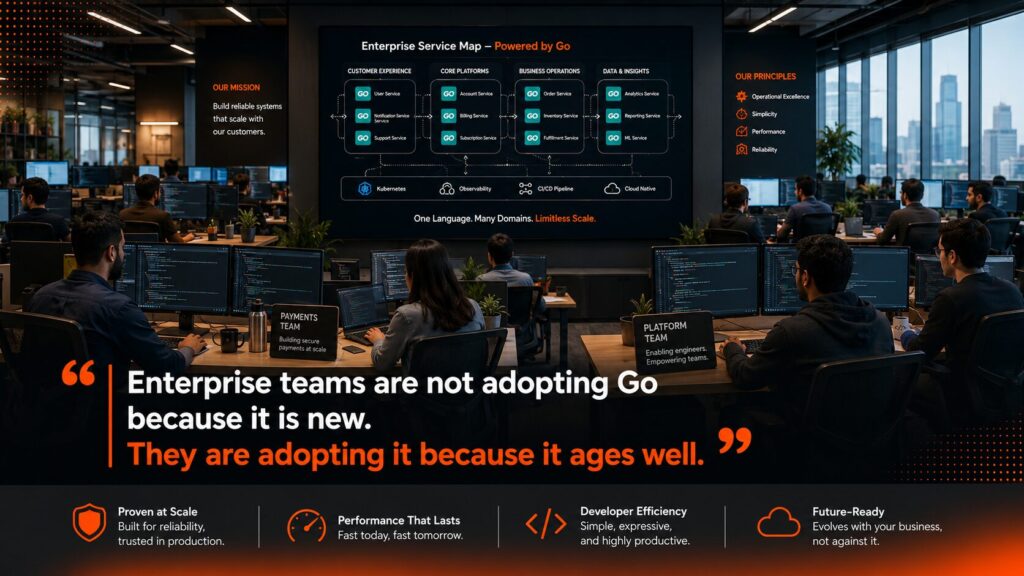
Enterprise go adoption tells a different story than startup adoption. Enterprises do not move fast. When they commit to a language, it is because they have evaluated it carefully and believe it will hold up over a five-to-ten year horizon.
Large Companies That Bet on Go and Won
Uber uses Go across a significant portion of its backend — for trip dispatch, surge pricing calculations, and location services that handle millions of requests per minute. Cloudflare built its edge network infrastructure on Go. Dropbox rewrote performance-critical components in Go after finding Python inadequate at scale. These are not small experiments. They are production commitments on the kind of scale that leaves no room for language mistakes.
The pattern is consistent: companies with the engineering talent to evaluate options carefully keep choosing Go for their most demanding systems. That is a signal worth paying attention to.
The Maintainability Advantage That CFOs Actually Care About
Here is an angle that does not appear in most discussions about why companies use golang: maintenance cost.
Software that is hard to read accumulates expensive technical debt. Onboarding new engineers into complex, idiosyncratic codebases take months. The lost productivity compounds over the years.
Go’s enforced formatting, minimal syntax, and explicit error handling make codebases more readable over long time horizons. A Go codebase written in 2021 looks similar to one written in 2026 — the language’s stability means no major migrations, no framework rewrites, no ecosystem upheaval.
For a CFO looking at five-year engineering cost models, that predictability has real financial value. It is one of the underrated reasons enterprises go adoption has grown faster than most predictions expected.
Building Scalable Software With Golang: Where It Fits Best
Golang development is not universally the best choice. Knowing where it excels is as important as knowing why it excels.

High Traffic APIs and Real Time Systems
Go’s goroutine scheduler makes it exceptionally well-suited for systems that need to handle thousands of simultaneous connections — financial APIs, real-time data feeds, messaging platforms, ride-sharing dispatch systems. The memory footprint per goroutine is small enough that you can run tens of thousands concurrently on a single server without resource exhaustion.
This is where scalable software with golang delivers the most obvious business value. The raw throughput advantage over interpreted languages is consistent and measurable.
Microservices That Need to Stay Small and Fast
Small binary sizes and fast startup times make Go ideal for microservices. A Go container image can be under 10MB. Startup time is measured in milliseconds, not seconds. In a Kubernetes environment where services restart frequently and need to scale up quickly, those properties matter operationally.
DevOps Tooling and Infrastructure Automation
The golang cloud infrastructure space extends beyond application code. Go is the language of choice for building CLI tools, deployment automation, observability agents, and custom Kubernetes operators. Teams that invest in Go for their application layer often find the same engineers can own their infrastructure tooling as well — a meaningful reduction in operational complexity.
What the Future of Golang Looks Like for Product Teams
The future of golang is not a dramatic pivot. It is a continuation of the same principles that made the language valuable — with new application domains opening as those principles become relevant in new contexts.

Go and AI Infrastructure
The AI infrastructure boom has created massive demand for backend systems that can serve model inference at scale — handling thousands of concurrent requests with low and predictable latency. Go is well-positioned here. Several LLM inference frameworks and AI platform backends are being built in Go precisely because of its concurrency model and performance characteristics.
This is not Go replacing Python for model training. Python will continue to dominate that space. Go’s opportunity is in the serving layer — the infrastructure that sits between trained models and the end users who query them.
Go’s Growing Role in Web Assembly and Edge Computing
Go’s compiler supports Web Assembly (WASM) output, which has opened a path for Go code to run at the edge — in CDN environments, browser contexts, and serverless edge runtimes. This is still early, but golang ecosystem updates in 2026 have made the WASM compilation path more stable and production-ready than it was two years ago.
For companies building globally distributed applications, the ability to write business logic once in Go and deploy it at the edge is a meaningful architectural option that did not exist in practical form before 2024.
Hiredeveloper.dev - The Right Time to Invest in Golang Development Is Now

The Golang trends in 2026 point in one direction: Go is becoming the foundation language for modern backend infrastructure, not a niche tool for performance specialists. Enterprise go adoption is accelerating because the language has proven itself over a decade of production use. The golang ecosystem updates have made it more capable without making it more complicated. And the emerging opportunities in AI infrastructure and edge computing are expanding the surface area where Go creates value.
For product teams that have not yet invested in Golang development, the window where “we’re evaluating it” is a reasonable answer is closing. The companies that built their backend on Go three years ago are now reaping the benefits in infrastructure costs, system reliability, and engineering velocity.
If your team is ready to build with Go or scale an existing Go backend, the quality of the engineers you hire will determine how much of that potential you actually capture. HireDeveloper.dev helps product companies find and place pre-vetted Golang engineers from India’s strongest engineering communities, including our home base in Indore. Every developer is screened against real Go production criteria — concurrency patterns, API design, cloud integration, and system architecture. Most clients are onboarded within two to three weeks, with a 60-day replacement guarantee. If you are serious about modern development, let’s talk.