






Is AI Killing Software Jobs or Creating Smarter Teams? What Every CTO Must Know in 2026
Something uncomfortable is happening inside IT companies right now. Budgets are being questioned. Timelines that once seemed standard are now being called slow. Clients who never asked about AI six months ago are now walking into meetings with direct questions about how you use it.
And developers? Some of them are quietly scared. Not because AI has replaced them. But because nobody in their company is telling them what is actually happening, or what it means for their future.

This blog is written specifically for IT company owners, CTOs, CFOs, and CEOs who are trying to figure out what AI actually means for their business, their teams, and their competitive position. Not theoretical future talk. Real, ground-level impact that is already happening in companies like yours.
We will cover the fear first, because it is real. Then we will walk through what AI is actually doing inside software companies. And then we will show you what smart companies are doing about it, because the ones adapting early are already pulling ahead.
Why AI Is Making Every IT Company Nervous Right Now
Let us be honest about the current mood inside most IT businesses. There is a tension that is hard to name but very easy to feel. Leadership teams are pushing for AI adoption without fully understanding what it changes. Developers are worried their roles might shrink. Middle managers are unsure whether to invest in training their existing teams or just hire differently.
Clients are not waiting for you to figure it out. They have started asking direct questions. Why does this project still need a team of eight developers? Why is this feature taking three weeks when they read an article saying AI can generate code in minutes?
The fear inside IT companies is not really about technology. It is about uncertainty. Nobody wants to be the company that invested in the wrong direction and lost ground to a competitor that figured it out first.

A global study by McKinsey in 2024 found that 70% of companies were experimenting with AI in at least one business function. But only 22% had operationalized AI in a way that actually changed how their teams worked. The gap between experimenting and adapting is where most companies are sitting right now.
This gap is exactly where the real risk lives. Not in AI itself, but in treating it like a productivity tool while your competitors are treating it like a structural shift.
What Your Competitors Are Already Doing
There are IT companies right now, some of them your direct competitors, that have quietly restructured how their teams operate. They have smaller core engineering teams. They are delivering faster. Their margins are improving because they need fewer hours to produce the same output.
They are not doing this by firing developers. They are doing it by multiplying what each developer can do. And that gap between your output speed and theirs is going to become visible to your clients very soon, if it has not already.
What Has Actually Changed in Software Development After AI
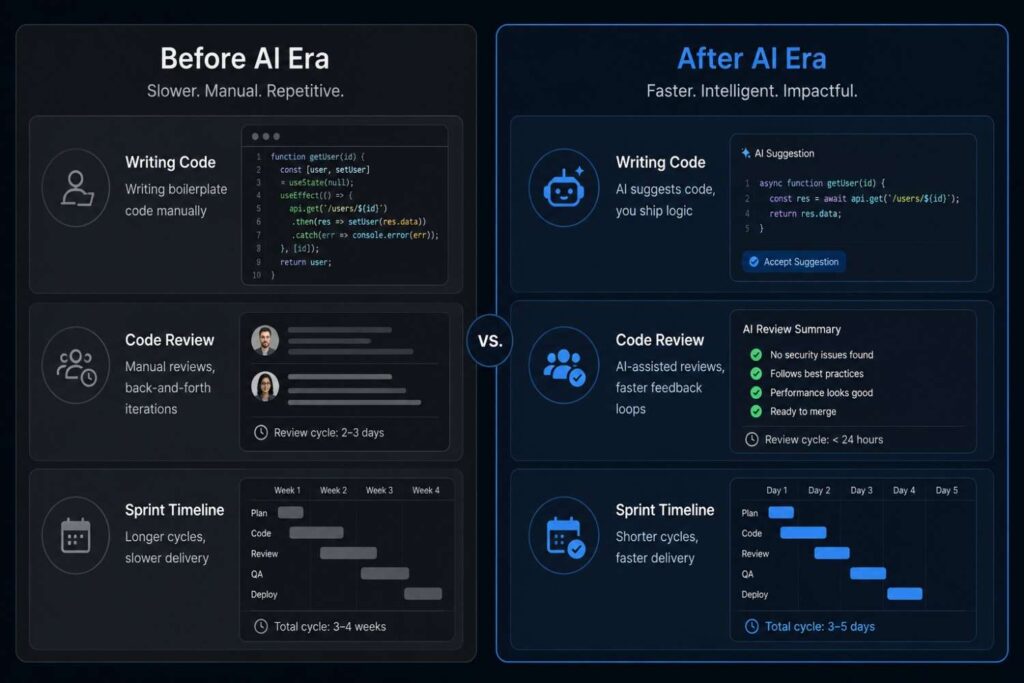
The shift in software development is not theoretical anymore. The tools are here, the workflows have changed, and the numbers are starting to show up in delivery data.
Speed Has Changed Fundamentally
Code that took a senior developer two days to write from scratch is now being drafted in a few hours. This is not an exaggeration. AI-assisted coding tools like GitHub Copilot, Cursor, and others are generating accurate boilerplate, suggesting entire functions, catching errors mid-write, and auto-completing logic that would previously have required research and careful thought.
Documentation, which most developers understandably hate writing, is now being generated automatically from code. Test cases that once had to be written by hand are being scaffolded by AI. API integration code that required reading through lengthy documentation is being produced in minutes.
The Abstraction Layer Has Moved Higher
This is something no blog has explained clearly yet, so pay attention to this point. In software development, every major technological shift has moved developers up one layer of abstraction. Assembly language gave way to high-level languages. Manual memory management gave way to garbage collection. Raw SQL gave way to ORMs.
AI is doing the same thing, but the shift is bigger. Developers are now moving from writing implementation code to directing AI systems, reviewing outputs, correcting logic, and designing architecture. The actual typing of code is becoming a smaller part of the job. The thinking, the judgment, the architecture decisions are becoming the entire job.
This is fundamentally different from every previous automation wave. Previous waves automated tasks that did not require intelligence. AI is automating tasks that look like they require intelligence but are actually pattern-based. What remains is the work that genuinely requires contextual understanding, business judgment, and creative problem-solving.
Client Expectations Have Permanently Shifted
When a startup with two developers launches a product that six months ago would have required a team of twelve, your clients notice. When competitors deliver MVPs in three weeks instead of three months, your delivery timelines start looking slow even if they are completely reasonable by pre-AI standards.
The benchmark has changed. What used to be considered fast is now being questioned. What used to be considered a standard team size is now being scrutinized. This is the market pressure that CTOs and CEOs should be most focused on right now.
Three Years of AI in Software Development: What the Numbers Actually Show
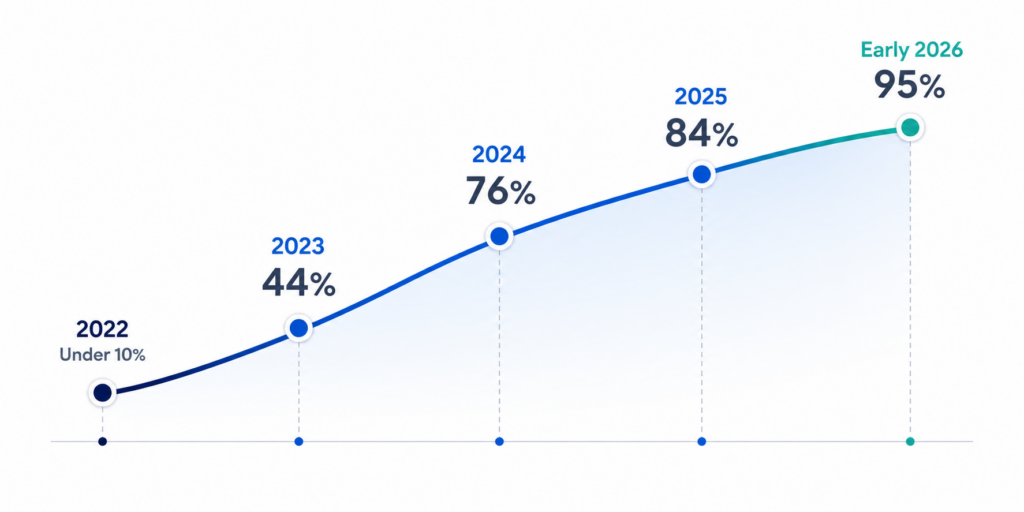
You have read the industry conversation about AI. This is what the data underneath that conversation actually says, because your decisions about team structure, hiring, and client positioning should be grounded in numbers, not noise.
How Adoption Has Moved Year by Year
| Year | Adoption | Stage | Key Data Point | Source |
|---|---|---|---|---|
| 2022 | <10% | Experimental | GitHub Copilot launched commercially in June 2022. AI coding tools existed but awareness was low across most professional teams. | GitHub |
| 2023 | 44% | Awareness | 77% used ChatGPT for coding; 46% used Copilot regularly. Enterprise gen AI use stood at 33% of business functions. | JetBrains Ecosystem Survey, Stanford HAI |
| 2024 | 63–76% | Mainstream | 63% actively using AI, 14% more planning to. 97% of developers across four major markets had tried gen AI tools at work. Enterprise gen AI doubled to 71%. | Stack Overflow 2024, GitHub, Stanford HAI |
| 2025 | 84% | Default infrastructure | 84% using or planning to use AI tools. 51% report daily usage. AI is no longer evaluated — it is expected development infrastructure. | Stack Overflow Developer Survey 2025 |
| Early 2026 | 95% | Structural shift | 95% using AI at least weekly; 75% use AI for half or more of their work. Reviewing AI-generated code (11.4 hrs/week) now outpaces writing new code (9.8 hrs/week) for the first time. ~41–50% of all code is now AI-generated or substantially AI-assisted. | Pragmatic Engineer Jan–Feb 2026, Digital Applied Q1 2026 |
The numbers in this table tell a story that moved faster than any previous technology shift in software development. In 2022, using AI tools made you an early adopter. By 2025, not using them makes you the outlier. By early 2026, the shift has gone further still, 95 percent of developers are using AI at least weekly, and for the first time, reviewing AI-generated code is now taking more hours per week than writing new code. That is not a productivity statistic. That is a structural change in what the developer job actually is. When your clients ask how your team uses AI, they are not asking out of curiosity. They are asking because their entire industry has already moved, and early 2026 data shows the pace is not slowing down.
Where AI Is Being Used Inside Software Teams
The most common uses developers report are generating boilerplate and repetitive code, writing unit tests and test scaffolding, catching bugs during code review, auto-generating documentation from existing code, and integrating APIs without manually reading through lengthy documentation. These are not peripheral tasks. Combined, they represent a large portion of the hours a developer spends in a typical sprint. The cognitive load reduction from removing these tasks from a developer’s plate is what produces the productivity multiplier that does not show up in any single task metric.
By early 2026, AI agent usage has added a new layer to this picture. 55 percent of developers now regularly use AI agents — autonomous systems that can take sequences of actions without step-by-step human direction. Senior engineers are leading this adoption at 63.5 percent usage, and teams using agents report being twice as enthusiastic about AI’s impact compared to developers using standard AI assistance alone.
The Productivity Numbers That Actually Matter
A controlled experiment by MIT, Microsoft, and GitHub researchers gave 95 professional developers the same coding task split into two groups. The group using GitHub Copilot completed the task 55.8 percent faster — 1 hour 11 minutes versus 2 hours 41 minutes. Task success rate also improved, from 70 percent without AI to 78 percent with it. A separate three-month production study tracking 800 developers confirmed a 55 percent reduction in lead time to production for AI-assisted teams, with code coverage improving and change failure rate holding steady. By 2026, developers consistently report saving between 30 and 60 percent of time on coding, testing, and documentation. Daily AI users are merging approximately 60 percent more pull requests than non-users. Between 60 and 75 percent of developers using AI tools report feeling more fulfilled in their work. 88 percent say AI helps them maintain better focus during repetitive tasks.
The Business Investment Behind the Numbers
Enterprise AI spending grew from USD 1.7 billion in 2023 to USD 37 billion in 2025. For every one dollar invested in generative AI, companies report an average return of 3.70 dollars. 92 percent of companies plan to increase AI budgets within three years. The generative AI market is projected to grow from USD 22 billion in 2025 to USD 325 billion by 2033. By early 2026, the AI coding tools market alone had reached USD 12.8 billion, up from USD 5.1 billion in 2024, and 78 percent of Fortune 500 companies now have AI-assisted development in production. The market is not speculative. It is already at scale and the spending your clients are committing is committed.
Will AI Replace Developers? The Honest Answer
Every developer reading this deserves a straight answer, not a reassuring corporate non-answer. So here it is.
AI will not replace great developers. But it will absolutely replace developers who refuse to evolve.
That sounds harsh, but it is the truth that will save careers if people actually internalize it.
Why AI Cannot Fully Replace a Developer
AI generates code based on patterns it has learned. It is exceptionally good at producing standard implementations, recognizing common structures, and suggesting solutions that match what has been done before. It has no ability to understand the specific context of your business, the legacy constraints of your existing system, the political dynamics of your team, or the strategic direction your product needs to go.
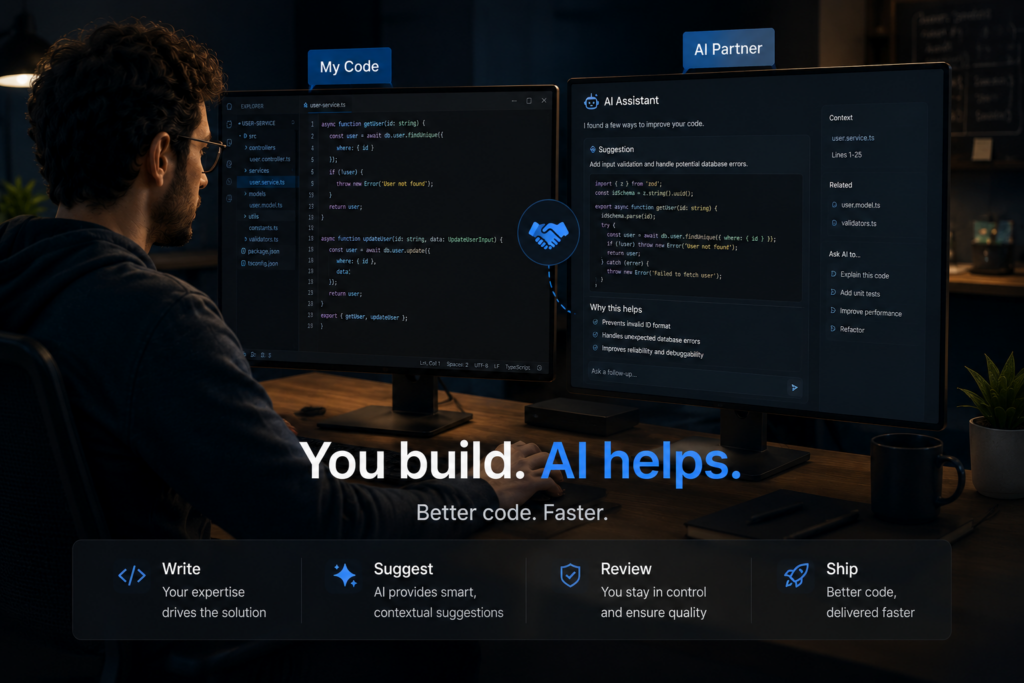
When a client comes to you with a problem that has never been solved exactly this way before, AI cannot reason through it the way an experienced engineer can. When an architecture decision needs to account for five years of technical debt, a compliance requirement that changed last quarter, and a scaling target that does not exist in any training data, AI is a tool. The engineer is still the one doing the actual work.
What Developers Need to Understand Right Now
The fear of replacement is real but it is aimed at the wrong threat. Developers should not fear AI. They should fear becoming the kind of developer who cannot work with AI.
The developers who will be most valuable in the next five years are the ones who can do the following. They will be able to direct AI tools to generate working code and then review it with enough skill to catch the mistakes AI makes. They will understand system architecture deeply enough to guide AI outputs toward correct long-term solutions. They will be able to communicate business requirements into technical specifications that AI can act on. They will maintain the judgment to know when AI output is wrong, incomplete, or dangerous.
The interesting thing about AI in development is that it raises the floor and raises the ceiling at the same time. Junior developers can now produce work that looks like mid-level output. But the gap between a good AI-assisted engineer and a great one has actually gotten bigger, not smaller, because great engineers know exactly what to look for in AI output.
What IT Company Leaders Need to Understand
For CTOs and CEOs, the developer replacement question is actually a distraction from a more important strategic question. The real question is whether your company structure, billing model, and talent acquisition strategy are designed for an AI-assisted world.
If your competitive advantage has been the size of your developer pool, that advantage is eroding. The companies winning right now are the ones whose advantage is the quality of thinking, the speed of delivery, and the intelligence of their systems.
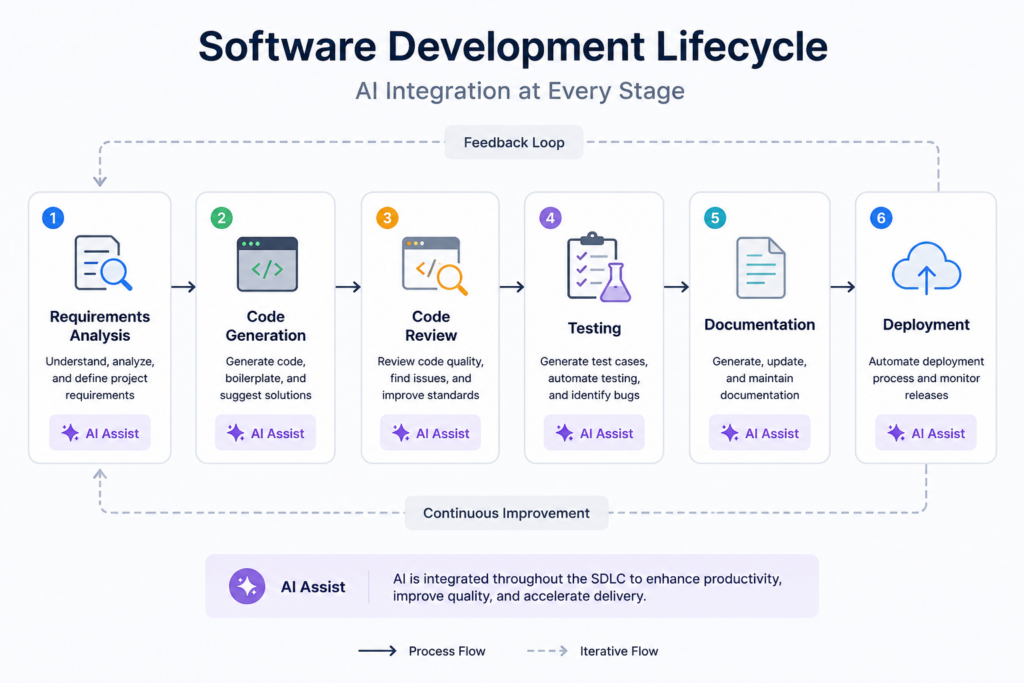
How AI Is Speeding Up Software Production Right Now
Talking abstractly about AI productivity is not useful. Let us look at where it is actually changing the speed of software delivery inside real teams right now.
Requirements to First Working Code
In traditional development, the time between a clear requirement and working code is measured in days or weeks. With AI-assisted development, experienced developers are reporting that the time to a working first draft of a feature has dropped by 40 to 60 percent depending on the complexity. This is not finished code. But it is code that is structurally correct, well-commented, and ready for review rather than ready to be written.
Bug Detection and Resolution
AI code review tools are catching bugs that previously slipped through peer review because they are pattern-based and tireless. They do not get fatigued at the end of a sprint. They do not miss an edge case because they were in three meetings that day. Teams using AI-assisted review are reporting significant reductions in bugs reaching production, which directly reduces the costly rework cycles that eat into project margins.
Documentation and Knowledge Transfer
One of the most expensive invisible costs in software development is poor documentation. When a developer leaves a project, the knowledge they carry about why certain decisions were made often leaves with them. AI is changing this. Code documentation is being generated automatically. Decision logs are being structured and maintained. Onboarding time for new developers joining a project is decreasing because the context they need is being systematically captured.
Testing Infrastructure
Writing tests is one of the most time-consuming and often skipped parts of development. AI tools are now generating comprehensive unit test suites from existing code, suggesting edge cases that human testers miss, and maintaining test coverage as code evolves. Teams that previously had low test coverage because of time pressure are now maintaining much higher coverage with no additional manual effort.
Something Most Blogs Miss: The Hidden Productivity Multiplier
Here is an insight you will not find in most content about AI and development. The biggest productivity gain from AI is not in the tasks it directly automates. It is in the cognitive load reduction it creates for developers.
When a developer does not have to hold an entire boilerplate structure in their head to write it from scratch, when they do not have to context-switch to look up an API signature they use twice a year, when the repetitive syntax work is handled, their mental bandwidth for the hard problems gets larger. The thinking quality goes up because the cognitive overhead goes down. This is a multiplier effect that does not show up in any individual task metric but shows up clearly in overall output quality and developer wellbeing over time.
The Real Challenges Nobody Talks About
Most AI content focuses on the upside. The productivity, the speed, the cost reduction. But if you are making decisions for an IT company, you need to understand the real challenges that come with AI adoption. Not hypothetical risks. Actual operational problems that companies are running into right now.
Over-Reliance on AI Output Without Sufficient Review
This is happening in teams that rushed adoption without building the right review culture around it. AI-generated code looks correct. It is syntactically clean, well-formatted, and often well-commented. But AI does not know your system. It does not know that a function it is generating will create a race condition with another part of your codebase. It does not know that the pattern it is suggesting was evaluated and rejected six months ago because of a specific edge case.
Teams that treat AI output as done rather than as a first draft are accumulating technical debt faster than they realize. The code ships, it works in testing, and then it causes subtle problems in production that take weeks to trace.
The Skills Gap That AI Creates Alongside the Productivity It Delivers

Here is a challenge that is genuinely new and that most companies have not planned for. Junior developers who learn to code with AI assistance from the beginning may develop very strong skills in reviewing and directing AI but weaker foundational skills in writing code from scratch.
This creates a future risk. If AI tools become unavailable, if a specific model changes in ways that break your workflow, or if a developer needs to work in an environment where AI tools cannot be used for security reasons, the team that has developed deep foundational skills will be far more resilient.
IP and Security Exposure
This is one that CFOs in particular should pay close attention to. When developers feed code into AI tools, especially commercial cloud-based ones, there are real questions about where that code goes, how it is used in training, and what your contractual and legal exposure is.
For companies building products for clients in regulated industries, healthcare, finance, legal, the liability questions around AI-assisted development are not fully resolved. Getting ahead of this with clear policies is not optional. It is a risk management requirement.
Organizational Resistance That Leadership Underestimates
The change management challenge of AI adoption is consistently underestimated by technical leaders. Developers feel the threat to their identity and their career trajectory. Senior engineers who built their reputation over fifteen years feel uncomfortable seeing junior developers produce similar output quality with AI assistance. Managers who built their value on managing large teams feel the uncertainty of what their role looks like in a smaller, more AI-augmented team.
These are real human dynamics that do not get resolved by sending a company-wide email about AI strategy. They require deliberate change management, clear communication, and leadership that is willing to be transparent about what is changing and why.
Where AI Actually Fails: The Data Behind the Hype
The previous section covered the organizational and cultural risks of AI adoption. This section covers what the data has confirmed at scale about where AI technically breaks down, because the companies handling AI well are not the ones who avoided these failure modes. They are the ones who understood them early enough to build review processes around them.
The Trust Decline Nobody Planned For
Developer trust in AI tools peaked at above 70 percent positive sentiment in 2023. By 2024 it had dropped to 40 percent. By 2025 it sat at 29 percent positive. This is not developers resisting change. It is developers with twelve to eighteen months of real experience encountering failure patterns that were invisible in the first few weeks of use. The companies that do not understand this trust curve are the ones whose developers quietly stop using AI tools after six months and nobody in leadership knows why.
The “Almost Right” Problem, And Why It Is the Most Expensive One
The most common AI failure, cited by 66 percent of developers in Stack Overflow’s 2025 survey, is AI producing code that is structurally clean, well-formatted, and passes casual review — but misses a context-specific edge case, an interaction with another part of your codebase, or a constraint that was never in the prompt because the developer assumed it was understood. This failure is dangerous precisely because it does not look like a failure. It ships, it passes testing, and it causes a subtle production problem three weeks later that takes two days to trace.
The second major failure, reported by 45 percent of professional developers, is that debugging AI-generated code costs more time than writing it from scratch. When AI produces plausible but flawed code, a developer must reverse-engineer logic they did not write in a style they did not choose with no original intent available to guide them.
Security and Hallucination: The Numbers Your CFO Should See
Close to 50 percent of AI-written code introduces vulnerabilities from the OWASP Top 10 security risk list when used without structured review processes. A separate study analyzing 576,000 code samples across 16 large language models found that 19.6 percent of AI-recommended software packages do not actually exist. Open source models hallucinated at a 22 percent rate. Even commercial tools hallucinated real-looking but nonexistent dependencies of approximately 5 percent of the time. Attackers have taken notice. By registering malicious packages under the hallucinated names that AI tools consistently suggest, they have created a new supply chain attack vector that conventional security tools were not designed to detect. For companies building software in healthcare, finance, or legal, this is not a theoretical risk. It is an active one.
Two Failure Patterns the Data Does Not Capture But Your Team Will Recognize
The first is over-explanation. AI generates comments that restate what the code obviously does. Developers start skipping comments entirely because 80 percent are noise, which means the 20 percent that contain genuinely important context also get skipped. Documentation quality declines while documentation volume increases.
The second is over-specification. AI produces the most comprehensive generic version of a solution rather than the minimal version your context requires. A request for a simple data validation function returns a full library with configuration options and extensibility hooks the project will never use. Junior developers then treat that output as the standard and apply the same approach independently. The AI failure propagates into team coding culture long after the original output has been forgotten.
None of this means AI tools should not be adopted. It means your review culture needs to be deliberately designed for these specific failure patterns before you scale adoption.
Our Real Experience: How We Used an AI Copilot Inside Our Own HR Team
We want to share something specific from inside HireDeveloper.dev, because advice about AI from a company that has not used it themselves is worth very little.
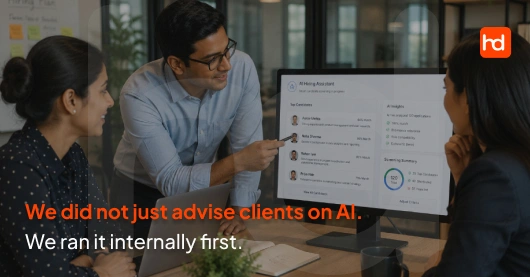
Six months ago, our HR team was spending a significant portion of their week on candidate screening. Reviewing developer profiles, checking for skill alignment, comparing experience against job requirements, drafting initial communication. It was repetitive, time-consuming, and it created a bottleneck when hiring volume increased.
We integrated an AI copilot into the screening workflow. Not to remove human judgment from hiring decisions, which we never considered, but to handle the pattern-matching work that did not require human judgment at all.
What Changed
The AI now handles the first pass of profile review. It checks for skill alignment, flags experience gaps, and surfaces relevant candidates based on structured criteria. Our HR team receives pre-filtered shortlists with notes on why each candidate was flagged rather than starting from a stack of applications.
The result was not what we expected. We expected speed. We got speed, but the bigger benefit was quality. Because our HR team was spending less time on pattern-matching, they had more capacity for the parts of hiring that genuinely require human judgment. Reference conversations. Culture fit assessment. Honest candidate communication about role fit. The quality of our hiring decisions improved alongside the speed.
What We Learned That No AI Tool Documentation Will Tell You
The AI copilot made mistakes in its first month. It flagged candidates who looked good on paper but had experience patterns that our team knew from context were red flags. It missed nuances in how certain developers described their work that experienced recruiters would catch immediately.
We did not fix this by replacing the AI. We fixed it by improving how we gave the AI context. The clearer and more specific we were about what we were looking for, and the more feedback we gave it on its errors, the better it got. The human skill that mattered most was not technical knowledge of AI. It was the ability to communicate requirements clearly and to review outputs critically.
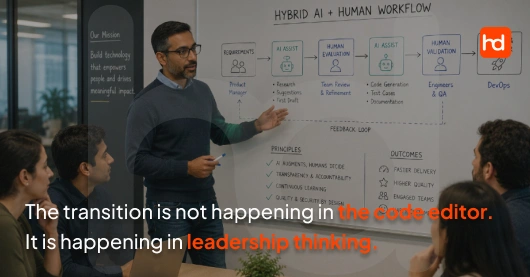
This mirrors exactly what we see in engineering teams. The AI is only as useful as the quality of direction it receives and the quality of review applied to its outputs. Intelligence and judgment are not replaced. They become more important.
What Smart IT Leaders Are Doing Differently Right Now
The gap between companies that are adapting well and companies that are struggling is not primarily a technology gap. It is a leadership and decision-making gap. Here is what the companies handling this well are actually doing.
They Are Redefining What Productivity Means
Companies that are doing this well have stopped measuring developer productivity purely in lines of code, tickets closed, or sprint velocity. They are measuring it in business outcomes. Features shipped and working in production. System reliability. Client satisfaction. Engineering decisions that hold up over six months.
This shift in measurement is actually what allows AI to be adopted correctly. When you measure outputs rather than activity, AI assistance naturally becomes valuable because it improves outputs. When you measure activity, AI adoption feels threatening to everyone because it appears to reduce the visible activity that people are being evaluated on.
They Are Investing in Architecture and Systems Thinking
The companies winning right now are building teams where the senior engineering roles are explicitly focused on architecture, systems design, and technical decision-making. They are not measuring senior engineers by their commit volume. They are measuring them by the quality of the decisions they make about how systems are built.
This is smart for a very specific reason. Architecture decisions are the one area where AI assistance provides the least leverage. AI can tell you patterns. It cannot tell you which pattern is right for your specific situation given your constraints, your team, and your business trajectory. Senior engineering judgment is becoming more valuable, not less.
They Are Building Honest Internal Communication Around AI
The companies navigating this well are not pretending everything is fine. They are having direct conversations with their teams about what is changing, what it means for roles, and what skills will matter in the next two years. They are investing in upskilling existing developers on AI tools. They are creating space for engineers to experiment with AI tools without the fear that the productivity gains they demonstrate will be used against them to justify downsizing.
They Are Changing How They Hire
Hiring criteria are shifting. The ability to work effectively with AI tools is now an explicit evaluation criterion. The ability to review AI-generated code critically is being tested. Candidates who can articulate how they use AI to improve their work, and who can also demonstrate strong foundational skills, are increasingly preferred over candidates who either refuse to use AI or rely on it without understanding what it produces.
How HireDeveloper.dev Helps You Navigate This Transition
At HireDeveloper.dev, we have spent the past year working through exactly what this transition means, first inside our own operations, and then in how we help companies build engineering teams that are designed for the world we are actually in.
We are a global software development and tech talent platform. We help businesses hire dedicated developers, build remote engineering teams, and scale end-to-end software development across web, mobile, IoT, AI, and cloud. But the way we think about what that means has evolved significantly.
We Help You Build AI-Ready Teams, Not Just Teams
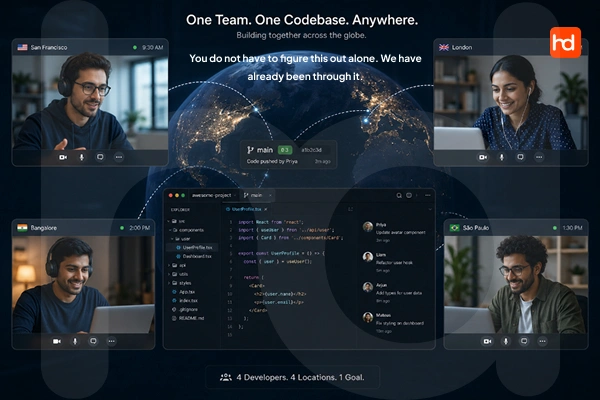
When companies come to us to hire developers or build engineering teams, we are not just matching skills to job descriptions. We are thinking about how each developer will function in an AI-assisted workflow. We evaluate whether candidates can direct AI tools effectively, review outputs critically, and operate with the kind of systems thinking that becomes more valuable as AI handles more implementation work.
We Help You Transition Existing Teams Without Losing What Works
Many of our clients are not starting from scratch. They have engineering teams that have been working together for years. The goal is not to replace them but to augment what they can do. We help with the workflow design, the tooling decisions, and the change management process that actually makes AI adoption stick rather than stall.
We Offer Flexible Engagement Models Built for the New Reality
We understand that the old model of billing for bodies and hours is under pressure. We offer engagement structures that are designed around outcomes and capabilities rather than headcount. Whether you need to scale a specific capability quickly, augment your existing team with specialized talent, or build an entirely new product team, our models are designed to give you speed and quality without the overhead of traditional hiring.
We Practice What We Advise
As we shared in the section about our HR team’s experience with AI copilot, we do not advise clients on AI adoption from the outside. We have been running it internally, learning from the mistakes, and building the knowledge that comes from actual operational experience. When we say a certain approach works, it is because we have run it.