








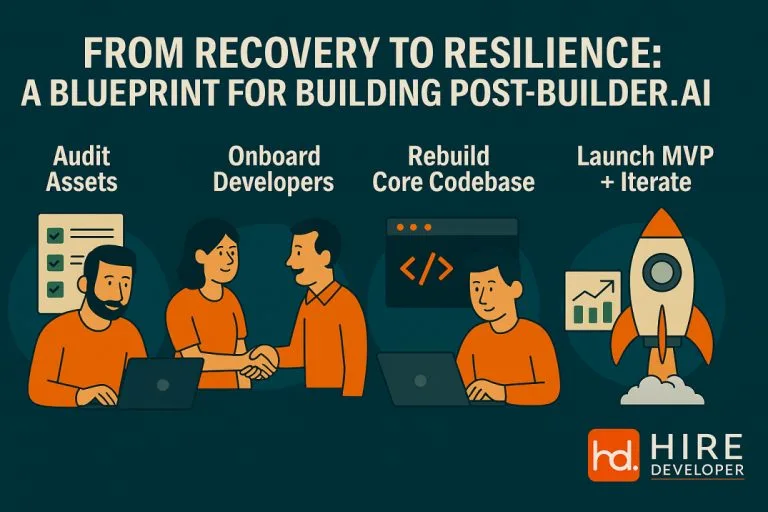
From Blueprint to Breakthrough: Start Building Smarter Software
Step 1: Design for Ownership
Everything starts with who controls what.
Ask yourself:
- Is the GitHub account in your name?
- Are staging and production clouds under your email?
- Can you onboard or offboard devs without approval?
This isn’t micromanagement. It’s the architecture of accountability.
Own the code. Own the infrastructure. Own the team’s rhythm.
Step 2: Assemble Transparent Teams
Resilience isn’t just about having people. It’s about knowing them.
- Meet every developer.
- Know their skill set and velocity.
- Align them to your roadmap.
- Remove layers that hide real conversations.
No vendor wall. No black box. No ghost teams.
At HireDeveloper.Dev, you run the squad, we just bring the firepower.
Step 3: Sprint Like a Startup, Think Like an Engineer
Velocity without visibility is chaos.
- Build in two-week cycles.
- Review every commit.
- Demo what’s shipped.
- Decide what’s next, based on actual progress.
Product resilience means your roadmap stays flexible, but your delivery stays accountable.
Step 4: Don’t Just Build. Prepare for Change.
Your next product decision shouldn’t be:
“Can we build this?”
It should be:
“If this fails, can we pivot?”
Resilient tech means:
- Modular architecture.
- Replaceable services.
- Backup-ready workflows.
- Transparent documentation.
If your system breaks, your team should know where, why, and how to fix it.
Step 5: Make Every Build Fundable
Every sprint should support your next round:
- Show Git activity.
- Present user journeys.
- Export product roadmaps.
- Share uptime, commit logs, and build pipelines.
Your startup isn’t just building tech. You’re building investor confidence.
And that’s the ultimate resilience, when your tech earns you more time, trust, and capital.
What HireDeveloper.dev Gives You (Beyond Developers)
With us, you don’t just get talent.
You get:
- Clarity on architecture, workflow, and output.
- Control over repos, sprints, and priorities.
- Continuity with devs who grow with you, not vanish mid-project.
- Credibility for investors, partners, and even your team.
We don’t replace platforms. We remove the dependency on platforms altogether.
Case Highlight: Building Back Better
A SaaS founder who lost everything on Builder.ai came to us with just one asset: a Figma prototype.
What we delivered in 6 weeks:
- MVP in their Git repo.
- Custom frontend + scalable backend.
- Cloud deployment under AWS.
- Audit-ready code + sprint log + docs.
Today, they’re onboarding their first paid clients, with zero vendor risk.
Quote: “We lost our product once. We’ll never lose it again. Now we build our own.”
Let’s Turn Recovery Into Resilience
HireDeveloper.Dev gives you more than developers, we give you control, continuity, and confidence, all in your name. In the wake of platforms like Builder.ai faltering, it’s time to build smarter, not just faster. With us, your product, code, and infrastructure stay truly yours.
Schedule your free consultation call now and start building the resilient way with HireDeveloper.Dev.
Related Resources:
- What Happened to Builder.ai? A Breakdown for Startup Founders
- How Builder.AI’s Collapse Shook the Startup World?
- How to React When Your Development Partner Fails Overnight?
- The 5 Stages of Vendor Grief and How to Get Unstuck
- Builder.ai’s Fall: Lessons for Product Owners and CTOs
- Builder.ai Migration Checklist: Save Your Code, Your Time, Your Product
- You Don’t Need to Start Over How to Transfer Your Project Safely
- From Panic to Progress, Real Strategies to Move on from Builder.ai
- Why Moving Fast Now After Builder.ai’s Collapse Will Save You Months Later
- How HireDeveloper.Dev Helps Builder.ai Clients Rebuild with Confidence
- Builder.ai vs. Human-Led Dev Teams: What We’ve Learned
- No More Black Boxes: The Power of Developer Transparency
- AI Was the Hype: Human Execution Is the Reality
- In Crisis, Founders Need More Than Just Tech: They Need Trust
- Why Owning Your Codebase Is Non-Negotiable in 2025
- Avoiding the Next Builder.ai: Red Flags Every Buyer Should Watch For
- From Locked to Liberated: How We Helped Former Builder.ai Clients Reclaim Control
- The Myth of One-Click Apps: Why Custom Always Wins in the Long Run
- What Every Investor Wants to Know: Technical Due Diligence After Builder.ai