






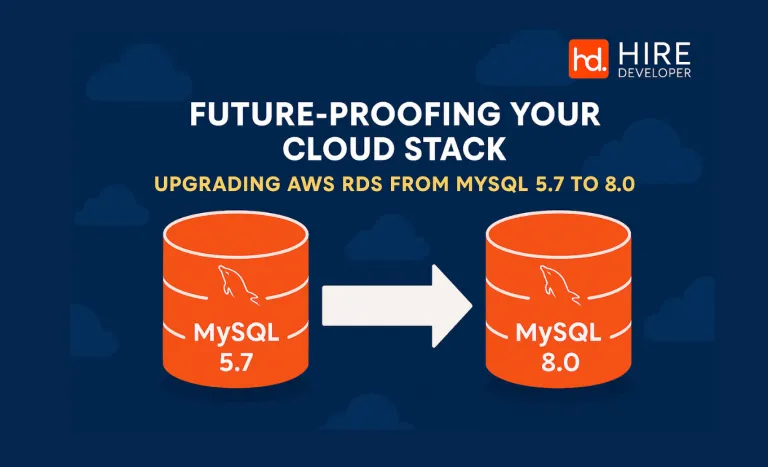
Why the Upgrade Matters
MySQL 8.0 isn’t just an upgrade; it’s a leap forward. It brings:
- Better Performance: CTEs, JSON improvements, window functions.
- Stronger Security: Advanced password policies, caching_sha2 authentication.
- Long-Term Support: MySQL 5.7 support ends soon, exposing your stack to vulnerabilities.
- Optimized Compatibility: Modern frameworks (Laravel 10+, Node.js 20+) perform better with 8.0.
2026 Flash Update: The Move to MySQL 8.4 LTS and Extended Support
The 2026 Flash Update shows the transition to MySQL 8.4 LTS with its ongoing support services. The MySQL 8.0 upgrade path became standard procedure during 2025, but Amazon RDS for MySQL 8.0 will stop standard support after July 31, 2026. The following technical updates will help you maintain both budget-friendly operations and safe infrastructure
MySQL 8.4 LTS serves as the target version for this project. MySQL 8.4 serves as the latest LTS release which the community now recognizes as the supported version. The 8.4 upgrade becomes mandatory because RDS Extended Support charges for version 8.0 will start on August 1, 2026.
MySQL 8.4 disables the mysql_native_password plugin as its default authentication method. Your application clients must support caching_sha2_password, or you need to re-enable the legacy plugin through your Parameter Group.
The RDS Blue/Green Deployments system allows for system upgrades which do not require any downtime. AWS has achieved better performance for its Blue/Green Deployments since January 2026. The maximum time for switchover operations in single-region setups now takes between 5 seconds and 5 seconds.
The MySQL 8.4 environment needs two new features to create a secure testing location while it protects all vital operations. The process allows you to conduct mysqlcheck tests along with performance assessments without affecting the operational status of your production system.
Critical Parameter Changes in 8.4
The system now works on default parameters which have been modified to match current SSD and NVMe hardware specifications because you will use version 8.4 instead of version 8.0:
The value of innodb_io_capacity has been raised from 200 to 10000.
The innodb_buffer_pool_instances value now depends on CPU and RAM usage since the system calculates it dynamically instead of using an 8 value.
The innodb_change_buffering value has changed to none as its default setting because current storage technology makes this optimization function less efficiently.
2026 Pro-Tip: Check your AWS Health Dashboard. Your system will enter Extended Support with AWS after July if you continue using 5.7 or 8.0. Extended Support requires organizations to pay high charges based on each CPU core used. Your transition to 8.4 LTS must begin immediately if you want to keep current pricing.
AWS Services Utilized
Our stack combined multiple AWS services to ensure control, speed, and scalability:
- Amazon RDS: Multi-AZ for high availability.
- AWS Backup: Snapshot creation and point-in-time recovery.
- CloudWatch: Real-time performance monitoring.
- S3: Used for offloading logs and maintaining rollback visibility.
- IAM: Controlled access during migration phases.
- DMS: AWS Database Migration Service is used for syncing data in a blue-green deployment.
Step-by-Step Migration Blueprint
Step 1: Audit and Validation: We ran MySQL Shell’s upgrade utility (util.checkForServerUpgrade) to detect schema-level and query compatibility issues. We exported slow logs to Amazon S3 and reviewed them with our database engineering team. Applications were reviewed for deprecated functions or version-dependent SQL statements.
Step 2: Sandbox Cloning and Testing: A full clone of the live RDS instance was made. This staging environment was rigorously tested using JMeter for load testing and Postman for API integration validation. This simulation revealed optimization opportunities in legacy queries.
Step 3: Schema and Index Optimization: We migrated from UTF8 to utf8mb4, restructured key tables, and improved indexing. Reserved keywords were replaced, functions updated, and full-text indexes tested to ensure MySQL 8.0 compatibility.
Step 4: Blue-Green Cutover Using DMS: We provisioned a new RDS instance running MySQL 8.0. With AWS DMS, real-time syncing was established between the old and new instances. DNS was swapped via Route 53 after validating read/write operations on the new node, ensuring a smooth switch with rollback readiness.
Step 5: Monitoring and Stabilization: CloudWatch metrics were monitored closely for 72 hours post-cutover. Alerts were configured for query time, disk I/O, and memory usage. Regular snapshots were taken, and error logs were piped for review. Users experienced no downtime.
Results at a Glance
- 22% faster average query execution.
- 35% improvement in API response for JSON-heavy data models.
- 15% cost savings by optimizing memory and IOPS usage.
Why This Isn't Just an Upgrade, It's a Transformation
Upgrading to MySQL 8.0 is not just about keeping up with support cycles. It’s about:
- Laying a performance foundation for AI, analytics, and ML layers.
- Enabling schema-level intelligence for smarter backend logic.
- Reducing the developer time spent debugging legacy constraints.
Why HireDeveloper.Dev?
We’re not freelancers. We’re not a recruiter. We’re an embedded tech partner.
With 150+ developers deployed, clients ranging from funded startups to global agencies, and full AWS-certified teams, we deliver migrations, system overhauls, and continuous improvement cycles like clockwork.
AI-Driven Hiring Backed by Real Delivery Beyond infrastructure, our AI-powered ATS uses GPT-4 to auto-screen candidates, assess project compatibility, and reduce hiring costs by over $100 per interview round.
It’s how we staff our projects and how your next RDS upgrade team could be built.
Need to Upgrade? Need Talent?
When your cloud demands scale and your product can’t wait, hire AWS developers who’ve been there, done that, and logged every detail.
At HireDeveloper.dev, your infrastructure is our commitment.