






The Direct Answer: What are the biggest basic auth IoT risks?
The primary risk of basic auth IoT is that it relies on static credentials (usernames and passwords) that are often hardcoded, easily intercepted, or vulnerable to brute-force attacks. Unlike modern IoT device authentication methods, basic auth provides no way to verify the unique identity of a device or ensure that the “handshake” hasn’t been compromised. In short, if a hacker steals one password, they potentially own your entire fleet.
Also Read: MQTT Vs HTTP For IoT: Security Pros Cons Analysis – MQTT Vs HTTP IoT Pros Cons
TL; DR: Why Basic IoT Device Authentication Is Killing IoT Security?
- The Problem: Basic Auth sends credentials in a way that is easily reversible and offers no protection if a device is physically tampered with.
- The Risk: Hardcoded passwords lead to massive botnets (like Mirai) and unauthorized access to sensitive data.
- The Solution: Move to certificate-based authentication (using PKI) or OAuth 2.0/Tokens.
- The Winner: For industrial and high-scale use, certificates are the gold standard for IoT device authentication.
The "Silent Killer" of Your IoT Network
We have all been there. You’re rushing to get a prototype off the ground, and you choose the easiest path: Basic Authentication. It’s simple to code; every library supports it, and it works.
But in the world of IoT, “simple” is often a synonym for “vulnerable.” As your network scales from 10 devices to 10,000, that simple username and password combination becomes a ticking time bomb. Let’s look at why basic auth IoT risks are dragging down the industry and what the pros are using instead.
Knowledge Booster: CERT-In IoT Compliance India 2025-26
1. Why Basic Auth is a Disaster for IoT?
Why Basic Auth is a Disaster for IoT?
The “Hardcoded” Nightmare
In traditional web apps, a user can change their password. In IoT, passwords are often hardcoded into firmware during manufacturing. If a vulnerability is found, you can’t exactly ask 5,000 smart lightbulbs to “click the forgot password link.”
No Identity Verification
Basic Auth tells the server what the password is, but it doesn’t prove who the device is. If a hacker intercepts the “packet” (the digital envelope) containing your credentials, they can perfectly impersonate your device.
The Lack of Granularity
With Basic Auth, it’s usually all or nothing. If a device is compromised, you often have to change the password on the server side, which might kick every other legitimate device off the network.
2. Certificate vs Password IoT: The Modern Showdown
Certificate vs Password IoT: The Modern Showdown
When we compare certificate vs password IoT, the difference is comparing a flimsy plastic padlock to a biometric vault.
- Passwords (Basic Auth): These are “shared secrets.” Both the device and the server have to know the password. If the server database is leaked, every device is compromised.
- Certificates (PKI): These use Asymmetric Encryption. The device has a “Private Key” that never ever leaves its hardware. The server has a “Public Key” to verify the device. Even if the server is hacked, the attacker doesn’t get the keys to your devices.
3. Better IoT Authentication Methods
Better IoT Authentication Methods
If you’re moving away from Basic Auth, here are the three paths most successful startups take:
-
X.509 Digital Certificates (The Gold Standard)
This uses a Public Key Infrastructure (PKI). Each device gets a unique “digital birth certificate.” It is the most secure way to handle IoT device authentication because it allows for Mutual TLS (mTLS), where the device and server prove their identities to each other simultaneously.
-
Token-Based Auth (OAuth 2.0 / JWT)
There isn’t even a password. It uses a “token” that is temporary in nature. The token expires after some time, thus minimizing the risk. This works best for devices accessing web APIs.
-
SASTokens (Shared Access Signatures)
It’s very Common in cloud platforms like Azure or AWS, these are time-bound strings that grant specific permissions to a specific device for a limited window.
Real-Life Example of IoT device authentication: The Smart Camera Breach
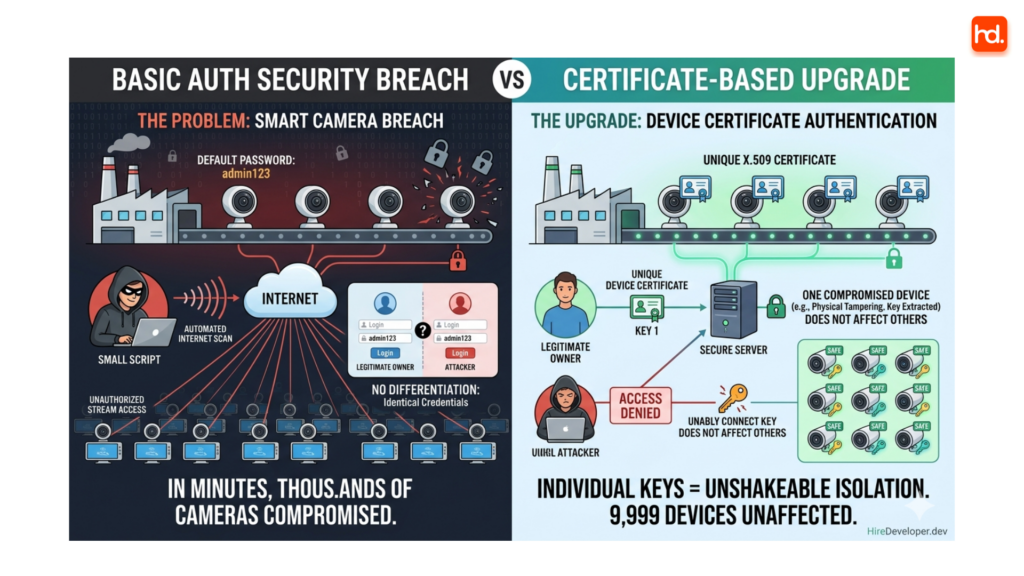 Consider an organisation that produces smart home security cameras. In order to simplify installation, each camera uses the same password (admin123).
A malicious attacker runs a small script that automatically searches for devices over the Internet. In minutes, the attacker gains access to thousands of camera streams. With Basic Auth, the company cannot differentiate the legitimate owner from the attacker because both use identical credentials.
The Upgrade: Device certificate authentication would mean that each device uses a different key. Even if one device gets compromised, physically taken apart, and its key extracted, all other 9,999 devices would be unaffected.
Building a "cool" product is easy; building a trusted product is what creates a lasting brand
At HireDeveloper.dev, we specialise in helping companies transition from “Basic” to “Brilliant.” Whether you need to implement a full PKI infrastructure or audit your current IoT authentication methods, our experts are here to help.