






Direct Answer: AWS IoT Core vs Custom PKI IoT System
The choice between AWS IoT Core vs custom PKI IoT systems depends on your scale and specialized needs. AWS IoT Core is a “managed” solution that handles the heavy lifting of device registration and certificate management, making it ideal for startups and rapid deployments. However, AWS IoT Core limitations include higher long-term costs and “vendor lock-in.” A custom PKI IoT system offers total control over your security root and significantly lower operational costs at massive scales but requires high-level in-house expertise to build and maintain.
Read More: Why Basic IoT Device Authentication Is Dangerous?
TL;DR: The Quick Comparison
- AWS IoT Core: Fast, managed, and secure out of the box. Best for teams that want to focus on their product rather than infrastructure.
- Custom PKI: Cost-effective at the million-device scale and offers “sovereign” security control. Best for industrial or highly regulated sectors.
- The “Secret”: AWS isn’t just a platform; it’s a workflow. If you leave AWS, moving your device’s identities to a custom PKI is a technical nightmare.
- The Recommendation: Start with AWS to prove your market, but architect for your firmware to be “CA-agnostic” so you can migrate later.
AWS IoT Core vs Custom PKI IoT System: What Nobody Tells You
 AWS IoT Core vs Custom PKI IoT System: What Nobody Tells You
 AWS IoT Core vs Custom PKI IoT System: What Nobody Tells You
When you’re ready to connect your first 10,000 devices, you hit a fork in the road. Do you go with the “Easy Button”, AWS IoT Core, or do you build a custom PKI IoT system from scratch?
Marketing brochures for cloud providers make it sound like there’s only one choice. But as a brand manager or CTO, you need to look at the “hidden” side of IoT platform comparison. Here is the raw truth about custom IoT security vs AWS.
The Managed Magic of AWS IoT Core
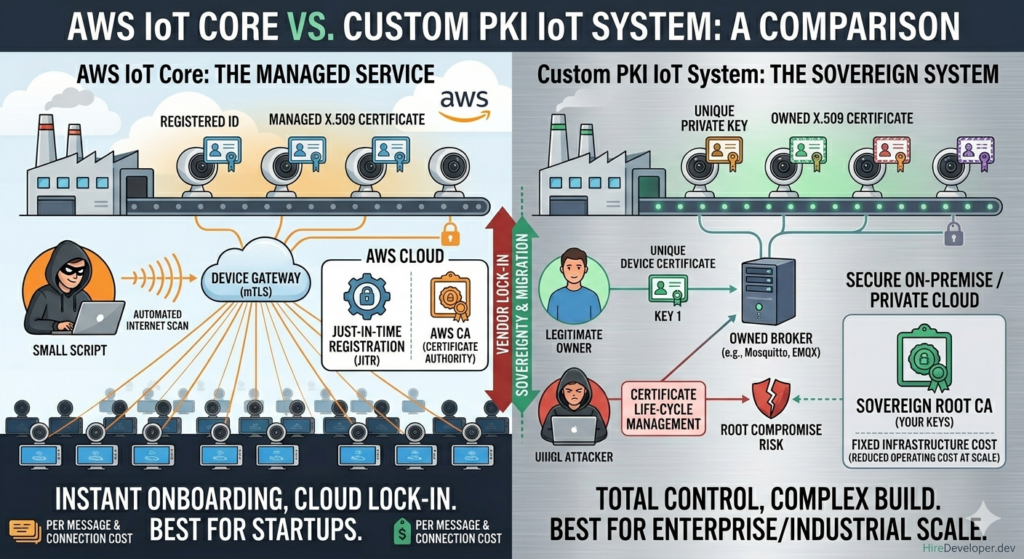
AWS IoT Core is like renting a high-security vault. They provide the guards, the cameras, and the locks.
- Zero-Touch Provisioning: AWS makes it incredibly easy to register devices using “Just-in-Time Registration” (JITR).
- Integrated Security: It natively supports X.509 certificates, meaning IoT device authentication is baked into every message.
- Scaling is “Invisible”: Whether you have 10 devices or 100,000, AWS handles the brokers’ stability for you.
The Hidden AWS IoT Core Limitations
They don’t mention the “Cloud Tax” in the documents.
Cost Traps: While AWS is inexpensive when dealing with small numbers, at one million devices, the costs per message and maintenance of active connections will literally drain your margins away.
Vendor Lock-in: After hardcoding your devices to rely on the AWS Root CA, a switch from AWS to any other cloud service, such as Azure or custom PKIs, would require a costly physical upgrade to all the devices’ firmware.
Restrictive Policies: You have no choice but to follow the guidelines imposed by AWS when it comes to certification of lifecycle management and Things names.
Why the Big Players Choose Custom PKI IoT Systems
A custom PKI (Public Key Infrastructure) is like building your own vault. It’s harder to build, but you own the keys.
- Sovereignty: You own the “Root of Trust.” If you want to move your devices from your own servers to a different cloud tomorrow, you can—because you issued the certificates, not a third party.
- Cost Efficiency: For massive deployments (logistics, smart cities), running your own PKI and an open-source MQTT broker (like Mosquitto or EMQX) can be 70% cheaper than AWS.
- Specialized Compliance: In sectors like defense or healthcare, CERT-In IoT compliance India or global HIPAA rules might require you to have absolute physical control over your Certificate Authority.
Custom IoT Security vs AWS: The Comparison Table
| Feature | AWS IoT Core | Custom PKI System |
|---|---|---|
| ⏱ Setup Time | Days | Months |
| 🧠 Required Expertise | Moderate (Cloud Engineer) | Very High (Security / Cryptographic Engineer) |
| 📈 Scalability | Automatic | Manual / Dev-Heavy |
| 💰 Long-term Cost | High (Per message/connection) | Low (Infrastructure costs only) |
| 🔐 Data Ownership | Shared / Managed | Absolute |
Choosing between AWS IoT Core vs custom PKI IoT isn't just a technical choice
Choosing between AWS IoT Core vs custom PKI IoT isn’t just a technical choice; it’s a financial and strategic one. At HireDeveloper.dev, we help founders navigate these complex waters. Whether you want to leverage the power of the cloud or build a sovereign, high-scale custom PKI, our developers have the expertise to build it right.