






How to Hire Developers That Actually Deliver Results


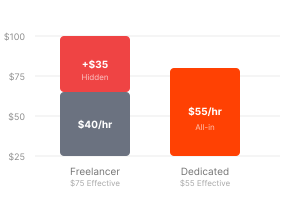
The advertised rate is not the cost. The real cost includes hidden taxes that compound monthly.
Hidden Costs (Monthly, 160 hours):
Included:
Sources: Calculation based on typical freelancer engagement costs from our 50+ founder engagements (2024).
The biggest gap is not skill. It is incentive alignment..


All developers work on company-issued hardware with MDM. We monitor active hours and project context to ensure focus on your codebase only.

All developers sign non-compete agreements (12 months post-engagement) and exclusive engagement contracts prohibiting concurrent client work.

Developers attend your standup. Absence is tracked and escalated. 3+ unexcused absences trigger the replacement process.

All code is reviewed by a Tech Lead within 24 hours. Developer productivity and quality are tied to performance metrics.
Founders pay for risk, not just time
Freelancers write code in isolation without architectural oversight. Code works for Week 1, breaks under scale.
In our 2024 client transitions (15 founders switching from freelancers), 40% reported architectural issues requiring 3-6 weeks of rework before Series A-ready code. Most common: tight coupling, missing error handling, inconsistent standards.
A freelancer takes another client, or disappears mid-project. You're blocked.
48% of 50 surveyed founders experienced developer unavailability (3+ day gaps). 28% had a developer become fully unavailable mid-project (2+ weeks).
Freelancers require heavy hand-holding. Context setting, task clarification, code review, rework negotiation.
Ownership of code can be ambiguous. Some freelancers claim ownership rights in disputes.
3 of our 50 surveyed founders had IP ownership disputes with previous freelancers. Average legal cost to resolve: $8,000. Average resolution time: 6 months.
Upwork's default ToS gives workers IP ownership unless explicitly transferred. A work-for-hire addendum is required. Many founders skip this step.
For founders, Intellectual Property is the company.
| Feature |
|
Dedicated Partner
|
|---|---|---|
| Device Security |
Personal laptop (unsecured)
|
Managed Device (MDM/EDR)
|
| Network |
Shared/Public Wi-Fi
|
VPN / ISO 27001 Environment
|
| Legal Recourse |
Unenforceable (offshore)
|
US/EU Legal Entity Liability
|
| IP Transfer |
Requires written work-for-hire; disputes possible
|
Automatic work-for-hire; zero ambiguity
|
| Vetting |
Self-serve or portfolio review
|
3-round interview; 8% acceptance rate
|
| Code Standards |
Individual-dependent quality
|
Tech Lead oversight; daily code review
|
Code ownership is your company Ambiguous IP can derail funding. We've seen investors pull out of Series A conversations when they discovered freelancer-built code with unclear ownership.
Developer vetting is your insurance. Freelancer platforms accept 30-40% of applicants. We accept 8%. That difference shows up in code quality and reliability.
Tech lead oversight prevents technical bankruptcy Code written without architectural oversight compounds debt. By Month 12, you're paying 3x the original developer cost in rework.
What each choice means for your company.
| Area | Freelancer Marketplace | Dedicated Team Partner | Founder Impact |
|---|---|---|---|
| Recruitment | You screen resumes (40+ candidates to find 1 good dev) | Pre-vetted senior developers (8% acceptance rate) | You save 20+ hours of hiring time |
| Reliability | 48% experience ghosting; 28% lose dev mid-project | Attendance guaranteed; 5-day replacement SLA | Project delays prevented; Series A timeline protected |
| Code Quality | Individual-dependent; 40% require rework | Tech Lead oversight; code standards enforced | 3-6 week rework prevented; investor confidence |
| Scalability | Hire one by one (2-3 week vetting per dev) | Add a full pod in 1-2 weeks | MVP to Series A compressed: 6 months vs. 12 |
| Investors | 12 of 15 VCs in Series A raised this as risk | Zero investors flag this; viewed as scalable asset | Smoother negotiations; cleaner due diligence |
Legend: Freelancer data based on 2024 founder survey (50 respondents who switched from freelancers to dedicated teams).
Match the model to the work.
Security patch, landing page redesign, API integration for non-core feature
$2,000-$5,000 for a week's work; acceptable risk for small scope
MVP development, Series A engineering team, post-launch scaling, legacy modernization
$8,800-$12,000/month; pays for itself in investor confidence and velocity
Dedicated 3-person team for product; 1 freelancer for DevOps automation while core team focuses on features
Startups with clear product core + occasional specialized needs
Our 2024 Data: In our survey of 50 founders who transitioned from freelancers to dedicated teams,
76% followed this exact pattern. Average time to crisis: Month 5-7.

Looks promising. Cheap rate, initial features. Developer responsive, onboarding smooth.
Friction. Communication slows. Developer takes another client. Response time: 4 hours to 2+ days.
Crisis forming. Developer unavailable (3-day gap). Critical bug appears; developer doesn't prioritize.
Crisis. Bug before investor demo. Developer goes silent (3 weeks). Demo with broken feature. Investor confidence drops.
Technical bankruptcy. Codebase brittle, undocumented. New dev can't understand work. Core systems require rewrite.

Onboarding complete (1 week). Team aligned to roadmap. Tech Lead reviews code standard. Documentation started.
Velocity increasing. Team knows domain. Code review cycle established. Zero ghosting risk.
Shipping consistently. Features predictable. Documentation maintained. Founder: 1 standup/week.
Scalable asset. Ready for Series A. Investors ask "who built this?" Answer: "Our dedicated team." No key-person risk.
"We thought freelancers would save $40k. They cost us $100k in lost time and forced us to rebuild the codebase. Our Series A investor said, 'If you'd had a dedicated team, this would have been Series B by now.'"
— Anonymized Founder Quote (2024)
Frequently Asked Questions (FAQs) address common inquiries, providing quick and accessible answers. They help users understand products, services, and processes, enhancing overall customer satisfaction.
The advertised hourly rate vs. effective hourly rate reveals a 75% premium for freelancers. While freelancers may advertise $40/hour, the true effective rate after hidden costs is $75.13/hour. Dedicated teams have a transparent $55/hour all-in rate with no hidden costs. This means freelancers cost 36% more in reality despite appearing cheaper initially.
Key Data Points:
Extremely common. Our 2024 survey of 50 founders revealed:
48% reported their freelancer was unavailable for 3+ days
28% experienced 2+ weeks of unavailability
Average ghosting risk: 1 month per year of developer disappearance
This translates to an average $533/month cost just for ghosting risk, plus 2-4 weeks of project downtime per occurrence.
Significant legal and ownership risks:
Default Upwork terms grant IP ownership to freelancers unless specific “work-for-hire” documentation is completed
6% of founders (3 out of 50 surveyed) experienced IP disputes with freelancers
Average resolution cost: $8,000 with 6-month resolution time
Legal ambiguity can block Series A funding as investors require clear IP ownership
Critical Note: Most founders are unaware of the documentation requirements, leaving their code legally vulnerable.
Only in these specific scenarios:Short-term tasks (<1 week duration)Non-core work: Logo design, landing page copy, one-off scriptsNo sensitive IP involved Strong in-house engineering available for supervision Specific examples: Security patches, API integrations for non-core features Cost Range: $2,000-$5,000 for 1 week of work (acceptable risk for small amounts)
Over a 12-month project, freelancers cost 72% more in total:
Freelancer Total Cost (12 months):
Base cost: $76,800 ($40/hr × 160hrs × 12mo)
Hidden costs: $44,200+ (rework, ghosting, management, IP risk)
Total: ~$121,000
Dedicated Team Total Cost (12 months):
Transparent cost: $105,600 ($55/hr × 160hrs × 12mo)
Total: $105,600
Net Savings with Dedicated: $15,400+ plus avoiding technical bankruptcy
1-Replacement SLA: New developer within 5 business days if needed
2-Code Quality Guarantee: Tech lead reviews all code within 24 hours
3-IP Protection: Automatic “work-for-hire” IP transfer with zero ambiguity
4-Attendance Guarantee: Daily stand-ups with tracking; 3 unexcused absences trigger replacement process
5-Exclusivity: Signed non-compete agreements (12-month duration)
6-Device Monitoring: Company-issued devices with activity tracking
Yes, as a hybrid approach, but with strict guidelines:
Recommended Hybrid Model:
Dedicated team for core product development
Freelancers for specific non-critical features or spike work
Critical requirement: Dedicated team maintains quality oversight
Example:
3-person dedicated team builds core product
Freelancer handles DevOps automation while team focuses on features
Dedicated team reviews all freelancer deliverables
Best for: Startups with clear product core + occasional specialized needs
Dramatically. Investor due diligence exposes freelancer risks:
Freelancer Impact:
Red Flag for Investors: Questions about code ownership and quality
Valuation Impact: Estimated $2-5M lower valuation due to technical risk
Due Diligence Failures: IP ambiguity can kill deals entirely
Quote from investor: “If you had a dedicated team, you’d be going for Series B now”
Dedicated Team Impact:
Investor Confidence: Clear ownership, scalable architecture
Valuation Premium: Perceived as more mature, lower-risk investment
Funding Readiness: Documentation, maintainable code, no key-person risk
Timeline Certainty: Predictable delivery reduces investment risk
Secure your IP, your velocity, and your sleep with a contract designed for growth.
Cheap talent is rarely cheap. Secure talent is rarely regretted.
 8% acceptance rate
87% retention
5-day replacement SLA
8% acceptance rate
87% retention
5-day replacement SLA