







Future Trends in IT Staff Augmentation | Predictions and Insights for the Industry Evolution
The IT sector continues to evolve due to shifting business requirements and technology breakthroughs. The workplace is an…



The best choice depends on readiness, not preference.
A single deployable system with strict internal module boundaries, enforced interfaces, and clear domain ownership. It reduces coupling and improves change safety without distributing operations.
Operational change: stronger boundaries, better testability, safer releases, clearer ownership with shared runtime.
A distributed system of independently deployable services with separate runtime boundaries and operational ownership. It increases flexibility but requires mature platform capabilities.
Operational change: service discovery, distributed tracing, incident response, service SLOs, data ownership, security posture across many runtimes.
Use this to qualify readiness before committing architecture.
| Constraint | Modular Monolith | Microservices |
|---|---|---|
| Domain boundaries clarity | ||
| Operational maturity | ||
| Observability and tracing | ||
| Release safety and rollback | ||
| Data ownership clarity | ||
| Team size for ownership | ||
| Compliance evidence |
| Factor | Modular Monolith | Microservices |
|---|---|---|
| Time to measurable outcome | Faster | Slower until platform is mature |
| Operational complexity | Lower | Higher, distributed operations |
| Change safety | High when boundaries enforced | High only with strong observability |
| Ownership model | Module ownership, shared runtime | Service ownership, service on-call |
| Data consistency | Easier, fewer distributed transactions | Requires explicit consistency strategy |
| Performance and latency | Often better, fewer network hops | Network overhead, requires careful design |
| Compliance evidence surface | Smaller | Larger, more control points |
| Best fit | Most legacy modernization programs | Mature orgs with platform capability |
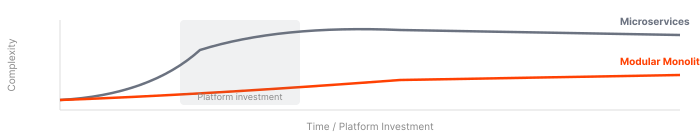
Complexity rises sharply early in microservices adoption, stabilizing only after significant platform investment.
If stable modular boundaries and release safety are not in place, the modular monolith comes first.
Prevention: establish bounded contexts and enforce modular boundaries first
Prevention: tracing, metrics, logs, and SLOs before scaling service count
Prevention: domain data ownership and consistency patterns defined early
Prevention: service ownership and on-call model aligned before decomposition
Prevention: fund platform engineering as a core workstream
Prevention: canary, shadow traffic, progressive delivery, tested rollback
In production, safety comes from controls, not architecture labels.
$ check_controls --production
[OK] Canary release enabled
[OK] Rollback path tested
[OK] Shadow traffic enabled for critical paths
[OK] Observability coverage complete
[OK] Dependency map validated
[OK] Incident runbooks current_
A safe sequence looks like this

Execution Evidence
See how we applied modular-first approaches to real enterprise systems with documented outcomes.
Context: unclear boundaries, small team, high uptime requirements, incidents during releases.
Decision: modular monolith first with enforced boundaries and release safety controls.
Outcome pattern:lower change failure and clearer domains for future extraction.
Context: stable boundaries, strong observability, multiple teams, independent deployment and scale required.
Decision: selective microservices extraction for domains where independence created measurable value.
Outcome pattern: measurable improvement without turning the whole system into distributed risk.
You receive:
Still have questions about Microservices vs Modular Monolith architecture? Explore our FAQs to better understand the differences, scalability factors, cost implications, and which approach fits your business goals.
Modular monolith is often the safer starting point because it improves maintainability without distributed operations overhead. Microservices is justified when domains are stable and operational maturity is already in place.
When bounded contexts are stable, observability is strong, CI/CD supports safe rollback, and teams can own services end-to-end.
Not by default. Downtime risk reduces with progressive delivery, observability, and tested rollback. Without those, microservices can increase failure surface area. Learn about zero-downtime controls
The operational tax: platform engineering, tracing, security controls across services, incident response, and service lifecycle management.
Yes. Many systems modernize successfully with modularization, refactoring, and selective extraction only where independence creates measurable value. Learn about application modernization
Domain boundaries, observability, rollback-capable CI/CD, on-call maturity, and a clear data strategy.

