







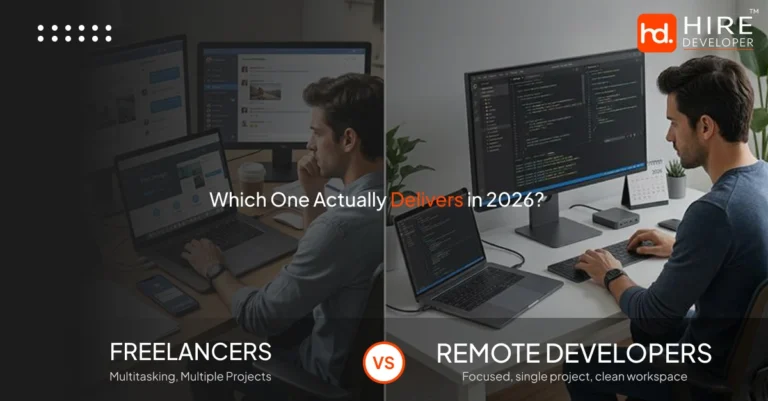
Why This Decision Matters More Than You Think
Hiring developers today is not just about getting work done. It is about building something that scales, holds up under pressure, and delivers real results over time.
Most businesses start with one simple goal: find someone affordable and get this built. That is exactly where the confusion begins.
On the surface, freelancers look like the smart, budget-friendly choice. Remote developers look like the expensive option you only need when you are “big enough.” But in reality, this thinking costs businesses far more than it saves.
The decision between remote developers vs freelancers directly impacts your delivery speed, product quality, long-term scalability, and total cost over time. Not just the hourly rate on the invoice.
If you are still figuring out the full hiring picture, start by understanding how to hire developers effectively before you choose a model.
Remote Developers vs Freelancers: The Quick Comparison
Before going deep, here is what the two models look like side by side.
| Factor | Freelancers | Remote Developers |
|---|---|---|
| Initial Cost | Low per task/project | Medium onboarding & trial |
| Hidden Costs | High rework, communication gaps | Low predictable monthly |
| Reliability | Uncertain availability varies | High consistent commitment |
| Scalability | Limited depends on individual | High team expansion possible |
| Control | Low limited oversight | High direct management |
| Long-Term Fit | Weak short-term focused | Strong strategic partnership |
| Availability | Shared across clients multitasking | Dedicated to you full focus |
| Onboarding Time | Repeated with each hire per contract | One-time smooth integration |
At first glance, freelancers seem like the obvious choice. Long-term reality, however, tells a very different story.
What Are Freelancers?
Freelancers are independent developers who work on multiple projects simultaneously, usually for different clients at the same time. They are available on demand, easy to hire, and seem inexpensive at first.
When Freelancers Work Well
Freelancers are genuinely the right choice in specific situations. They work best for small, clearly scoped tasks, short-term projects where no ongoing involvement is needed, non-critical features where code quality inconsistency is an acceptable risk, and one-off design or integration tasks that have a clear start and end.
Where Freelancers Fall Short
The model breaks down the moment your needs extend beyond a single task. Freelancers are optimizing for their own availability across multiple clients, not for the long-term health of your product. That shift in incentive is the root cause of most freelancer-related project failures.
They take on other work mid-project. Response times slow. Context gets lost. Code quality drops. And when something goes wrong, there is no accountability structure to fall back on.
What Are Remote Developers?
Remote developers are dedicated professionals who work as a full extension of your team. The only difference from an in-house hire is the physical location. Everything else, focus, accountability, long-term alignment, code ownership, is the same.
What Makes Remote Developers Different
A remote developer is working on your project, and only your project. They attend your standups, follow your architecture, build toward your roadmap, and take real ownership of outcomes. That is not something a freelancer structure can replicate.
Companies that plan to scale quickly often prefer to hire remote developers rather than relying on freelancers because the model supports actual growth.
Where Remote Developers Require More Setup
The tradeoff is onboarding. Bringing a remote developer into your workflow takes time upfront. Expectations need to be set, tools need to be shared, and context needs to be transferred. But this is a one-time investment. The stability and output quality you get in return compounds over time.
Remote Developer vs Freelancer Cost: What You Actually Pay
This is the section most people get wrong, and the reason so many projects go over budget.
The Freelancer Cost (Looks Cheap, Often Is Not)
| Cost Type | Reality |
|---|---|
| Base Hourly Rate | $20 to $50 (varies by skill level) |
| Rework (30 to 40% of projects) | Adds weeks and costs → missed deadlines, budget overrun |
| Communication delays | Multiple rounds of back-and-forth (asynchronous confusion) |
| Management overhead | 8 to 10 hours per week from your team → lost productivity |
| Context re-setting per hire | 1 to 2 weeks lost per replacement (onboarding, knowledge transfer) |
The base rate looks attractive. But once you add rework caused by code written without architectural alignment, the delays from juggling multiple clients, and the management time your team spends chasing updates, the effective cost per delivered feature is far higher than the invoice suggests.
The Remote Developer Cost (Structured and Predictable)
| Cost Type | Reality |
|---|---|
| Base Hourly Rate | $25 to $70 (varies by location and experience) |
| Rework rate | Significantly lower → structured processes, clear ownership |
| Management overhead | 2 to 3 hours per week from your team (mostly sync & reviews) |
| Context loss | Near zero over time (long-term collaboration, documentation) |
| Total cost predictability | High fixed monthly / predictable budget |
The rate is higher upfront. But the output is consistent, the rework is minimal, and your team spends far less time managing and re-explaining. The math, when run over a 6-month project, almost always favors remote developers.
Freelancers are cheap to start and expensive to scale. Remote developers are a slightly higher entry point that pays off clearly over time.
Hidden Costs Nobody Talks About
This is the biggest gap in most comparisons, and it is where the freelance vs remote developers debate actually gets decided.
The Rework Cost
When code is written without architectural oversight, it works for week one and breaks under scale. Industry data consistently shows that 30 to 40 percent of freelance development projects require significant rework before they can be extended or handed off. That is not a rounding error. That is a budget line item most businesses never planned for.
Communication Delays
Freelancers are handling three to four clients at any given time. When you need a quick answer or a fast turnaround, you are competing for attention. Response times slow. Deadlines slip. Context gets lost between conversations. These delays do not show up on the invoice, but they absolutely show up in your timeline.
The Management Tax
Managing a freelancer often becomes a part-time job. Someone on your team ends up spending 8 to 10 hours a week writing briefs, reviewing work, explaining context, negotiating scope, and following up on deliverables. That time has real cost, especially if it is coming from a founder or a senior leader.
Project Failure Risk
In the worst case, a freelancer disappears mid-project. The code is incomplete, poorly documented, or written in a way only they understood. You are left rebuilding from scratch. This is not rare. It is a known risk of the freelance model, and it is one of the main reasons companies eventually switch.
Real-World Scenarios: What Actually Happens
The Startup MVP Story
A founder hires a freelancer to keep initial costs low. The first few weeks look promising. By month two, response times have doubled. By month three, a critical feature is delayed because the developer took on another client. The MVP misses its launch window. The company ends up hiring a remote developer to fix and finish the work, paying twice for the same output.
The SaaS Company Scaling
A SaaS team decides to scale with remote developers. Onboarding takes two weeks. By month two, velocity is high and consistent. Code quality is reviewed continuously. Features ship on time. The team spends less time managing and more time building. Eighteen months in, the product is investor-ready.
The E-Commerce Hybrid
An e-commerce business uses a remote team for core product development and hires freelancers only for small, isolated tasks like a one-off script or a non-critical integration. The core product stays stable. The small tasks get done quickly and cheaply. This is the hybrid model in practice, and it works when the boundaries are clear. For a deeper look at where each model fits, the remote hiring guide breaks it down further.
The Hybrid Model: What Smart Companies Are Actually Doing in 2026
The framing of freelancers vs remote developers as a binary choice is outdated. In 2026, the companies getting the best results are running both in parallel, intentionally.
How to Use the Hybrid Model Well
Use freelancers for tasks that are small, bounded, and non-critical. A bug fix, a landing page update, a one-time API integration. Use remote developers for everything that touches your core product, your roadmap, your architecture, or your scaling decisions.
The key is keeping the boundaries clean. When core work bleeds into freelance engagements, quality drops and accountability disappears. When the hybrid model is run with discipline, you get cost efficiency and reliability at the same time.
Decision Framework: Choosing the Right Model
Stop trying to make a general decision. Make the right decision for the specific situation.
| Situation | Best Choice |
|---|---|
| Budget under $2,000 | Freelancer cost-effective for small tasks |
| Task under one week, clearly scoped | Freelancer fast turnaround, defined deliverables |
| Non-critical, standalone feature | Freelancer low risk, isolated work |
| Building an MVP | Remote developer consistent iteration & feedback loop |
| Scaling a product | Remote developer team expansion, architecture stability |
| Preparing for funding | Remote developer reliable codebase, investor confidence |
| Long-term development | Remote developer continuity, deep product knowledge |
| Core product plus occasional extras | Hybrid remote core team + freelancers for spikes |
Simple rule: short-term work with clear scope goes to a freelancer. Anything tied to the core product or long-term growth goes to a remote developer. For a detailed breakdown of how dedicated developers fit into this picture versus freelancers, the dedicated developers vs freelancers comparison covers the real numbers.
Risks You Need to Understand Before You Decide
Freelancer Risks
No ownership mindset, the incentive structure does not reward long-term quality. Inconsistent code quality with no oversight between deliveries. Availability risk, you may lose them at any point. IP and security exposure when using personal devices and networks. Repeated onboarding costs every time a freelancer cycles out.
Remote Developer Risks
Higher upfront commitment, the initial cost is real. Wrong hire impact is more significant because of deeper integration. Requires proper onboarding and communication setup from day one.
The difference is that remote developer risks are largely manageable and one-time. Freelancer risks are structural and recurring.
ROI and Long-Term Impact
The Freelancer Trajectory
Fast to start. Cheap in month one. Slows down in month three as priorities split. Rework appears in month five. By month twelve, the codebase has accumulated technical debt that costs more to fix than the original savings.
The Remote Developer Trajectory
Slightly slower start due to onboarding. Velocity increases steadily through month two. By month six, output is consistent, code quality is maintained, and the product is in a state ready for the next phase. Long-term ROI is substantially higher.
How to Hire the Right Developers Without Wasting Time
Regardless of which model you choose, the hiring process matters. Define your requirements clearly before you start. Specify the tech stack, project scope, and expected outcomes. Choose your model based on the framework above, not on instinct or cost alone. Screen for real skills using practical assignments, not just interviews. Start with a short paid trial before committing to a long engagement.
If speed is a priority, you can learn exactly how to hire remote developers in 3 days without going through a slow, manual process.
Final Verdict: Which One Should You Choose?
Freelancers are good for short-term work with clear boundaries. Remote developers are built for long-term growth, product ownership, and scalability. Most businesses that start with freelancers eventually switch because the model does not hold up as complexity and stakes increase.
The smarter move is to start with the right model for your goal, not the cheapest option available. Optimizing for hourly rate is how projects end up over budget. Optimizing for outcome is how products actually get built.
Hire Remote Developers Without the Hiring Chaos
If you are planning to build a reliable development team without spending weeks on screening, interviews, and uncertainty, there is a faster way to get there.
At HireDeveloper.dev, you can directly access pre-vetted remote developers who are tested on real-world projects, ready to start quickly, and aligned to your specific goals. Whether you need one developer or a full dedicated developers team, the process is built to remove the usual friction.
Skip the hiring struggle and start building with the right people from day one.