







Future Trends in IT Staff Augmentation | Predictions and Insights for the Industry Evolution
The IT sector continues to evolve due to shifting business requirements and technology breakthroughs. The workplace is an…


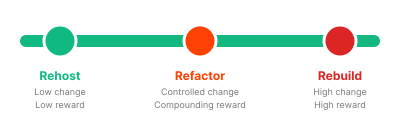
The best choice depends on risk tolerance, integration complexity, and internal capacity.
Moves the application to a new environment with minimal code change. Often called lift and shift. It reduces infrastructure constraints quickly but does not remove application fragility.
Best fit: data centre exit, infrastructure EOL, hosting reliability problems
Hidden risk: The same change risk and technical debt move with you
Improves code and architecture incrementally so change becomes safe, security improves, and maintenance cost drops. This is the option that improves delivery reliability over time.
Best fit: risky releases, tight coupling, security and audit gaps, slow change
Hidden risk: refactoring without sequencing becomes churn
Replaces the system with a new codebase. It is justified when the business process is changing and the current system cannot be decomposed safely.
Best fit:clean scope, controllable integrations, strong QA, reversible cutover
Hidden risk: long parallel run, late edge cases, cutover concentration
| Constraint | Rehost | Refactor | Rebuild |
|---|---|---|---|
| Speed to outcome | |||
| Risk control and rollback | |||
| Cost predictability | |||
| Integration complexity tolerance | |||
| Change safety requirement |
| Factor | Rehost | Refactor | Rebuild |
|---|---|---|---|
| Primary goal | Infrastructure exit | Reduce change risk | Clean architecture |
| Time to first outcome | 2-6 weeks | 2-8 weeks | 6-18 months |
| Cutover risk | Low | Controlled | High at cutover |
| Integration risk | Preserved | Reduced incrementally | Often underestimated |
| Compliance posture | Unchanged | Improved early | Addressed late |
| Cost profile | Infra-driven | Phased, predictable | High burn before value |
| Team capacity | Infra + Ops | Focused team + SME | Two-stack delivery |
| Best fit | Infra EOL, DC exit | Regulated, complex | Stable scope, clean break |
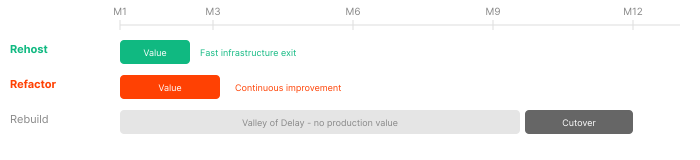
Rehost optimizes infrastructure timelines. Refactor optimizes change safety and long-term velocity. Rebuild optimizes clean architecture when scope is stable and cutover is controllable.
Deliverable: recommended path by module, rollout controls, phased plan
Rehosting moves the mess. It can improve infrastructure stability, but keeps application fragility and release risk intact.
Prevention: observability, access control tightening, release rollback discipline, dependency clarity.
Refactoring without sequencing creates churn and slows delivery.
Prevention: risk scoring, module prioritization, test gates, phased extraction.
The parallel run lasts longer than planned. Integrations and edge cases appear late, right before cutover.
Prevention: scope freeze, acceptance criteria, migration validation, reversible cutover design.
Replatform sits between rehost and refactor. You make moderate changes to use managed services or platform capabilities while keeping core business logic intact. It can reduce operational overhead and improve reliability without a full refactor.
Examples: managed database, container platform, PaaS migration
If the goal is safer delivery and faster change, refactor is still required. If the goal is infrastructure exit and stability, rehost or replatform may be enough.
For zero downtime environments, rollout controls matter more than the label. Rehost, refactor, and rebuild fail when cutover is treated as a single event.
$ check_controls --all
[OK] Canary release enabled
[OK] Shadow traffic enabled
[OK] Rollback path tested
[OK] Observability coverage complete
[OK] Dependency map validated
[OK] Parallel run validation planned
High-performing teams rarely pick only one. They sequence approaches to reduce risk early.

Keep the cutover reversible at every stage.
Context: Infrastructure EOL, stable business logic, high release risk..
Decision: Rehost to remove infra risk, then refactor high-risk modules to improve release safety..
Outcome: Infra exit without operational disruption, safer delivery through phased refactoring.
Context: Workflow redesign, many integrations, high availability constraints.
Decision: Refactor and modularize first to reduce dependency risk, then selectively rebuild redesigned modules with controlled routing.
Outcome:Avoided prolonged two-stack program and reduced cutover risk.
Execution Evidence
See how we applied this framework to real enterprise migrations with documented outcomes.
Still have queries? Check out our FAQs to get a better understanding of our services, pricing, and expertise. If you don't find what you're looking for, feel free to reach out to us directly.
Rehost moves an application with minimal code change. Refactor improves code and architecture incrementally to reduce change risk. Rebuild replaces the system with a new codebase and requires parallel run, migration validation, and reversible cutover planning.
Rehost is right when infrastructure exit, EOL pressure, or hosting reliability is the main driver and business logic can remain stable in the short term.
Refactor is the right call when releases are risky, coupling is high, or security and audit evidence gaps are the real blockers. Rehosting alone will not fix change failure. Learn about application modernization
Rebuild is justified when the business process must change, scope can be frozen, integrations are controllable, and you can support parallel run and reversible cutover.
No. Rehost is minimal change. Replatform includes moderate changes to adopt platform services and reduce operational overhead.
Controls decide success. Phased modernization with controlled routing is usually safest. Rebuild has higher cutover risk because it introduces more unknowns. Learn about zero-downtime controls
Yes. This is often the safest sequence. Rehost reduces infrastructure risk, then refactor reduces long-term change risk and improves delivery safety.

