





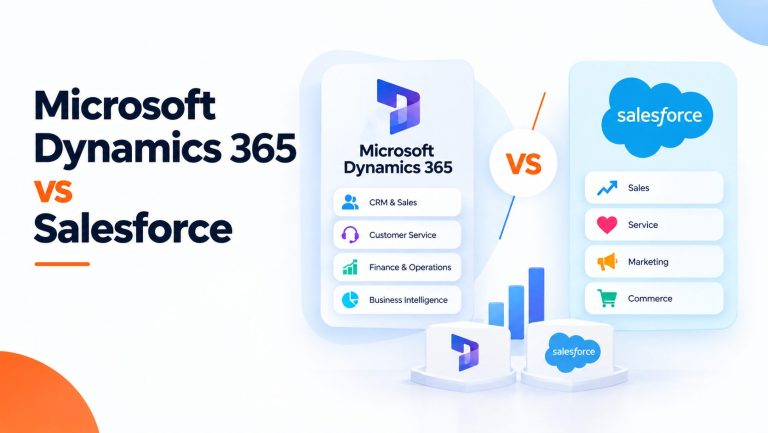
Microsoft Dynamics 365 vs Salesforce: Which CRM Is Better in 2026?


Application modernization focuses on code, logic, APIs, and user experience. System modernization focuses on infrastructure, databases, and runtime platforms.
Many organizations do not need to change everything at once. ,Modernizing the application layer first often delivers risk reduction without destabilizing foundational systems.
Clear scope boundaries prevent project creep and ensure focused, measurable outcomes.
Legacy web applications
Backend services and APIs
Application refactoring and modularization
Mobile app modernization (UI, flows, API contracts)
Enterprise platform or infrastructure transformation
Shared database replacement programs
Cross-system re-architecture initiatives
Note:Databases are treated as stable constraints. We improve access patterns and contracts first to reduce risk.
For foundational change, see Legacy System ModernizationLegacy applications rarely fail loudly at first. They fail through fragility. Modernization restores predictability, not novelty.

Every deployment feels like a gamble. Teams delay updates, accumulating more risk.

Only a few engineers understand the critical flows. Knowledge concentration creates risk.

Mobile apps cannot evolve because APIs are unstable. Innovation stalls at the interface.

Minor changes break unrelated features. Coupling turns small fixes into major incidents.
This framework prevents unnecessary rewrites while remaining honest about reality.
Decision Path
When
Business logic is correct, but the structure is fragile.
Outcome
Improves maintainability without altering behavior.
When
Runtime or deployment constraints limit reliability or scale.
Outcome
Logic remains stable while execution improves.
When
The application no longer reflects the business.
Outcome
Data is migrated and preserved. Historical integrity maintained.
Pattern Evidence
See how we applied this framework to a Yii 1.1 to Yii2 framework migration with production continuity.
A five-step approach that keeps production running while systematically improving the application.
Map real production behavior and usage patterns.
Introduce boundaries to contain legacy complexity.
Modernize one capability at a time.
Run new paths in parallel before adoption.
Shift traffic gradually with rollback available.

Production behavior monitored before and after every change.

Regression, integration, and contract testing before rollout.

All deployments include automated rollback path, as no change is irreversible. Here's how you can learn more about zero downtime deployment.
Mobile and backend evolution must be decoupled to avoid forced updates, broken sessions, and store-related delays.
UI and flows evolve while APIs remain stable. Users get improvements without backend changes.
Versioned APIs allow backend evolution without breaking existing mobile installs.
Backend evolves first. Mobile adoption follows. Avoids forced updates and store delays.
Get a refactor vs. replatform recommendation in a focused technical session.
We use AI as a decision-support layer to reduce modernization risk, especially in poorly documented codebases.
Dependency discovery and mapping
Undocumented API usage detection
Legacy behavior mapping and analysis
Constraint
Architecture decisions and production changes remain human-led. AI assists discovery, humans execute.

Architecture & Execution

Discovery & Analysis
Clear governance and commercial terms designed for enterprise procurement.

Architect-Led
Each engagement is led by a senior application architect.
Stable Teams
No unapproved mid-engagement team changes.
Exit Rights
Pause or terminate at phase boundaries without lock-in.

Assessment
Fixed-scope diagnostic with clear deliverables.
Execution
Time & material with phase-level caps.
Payment
Milestone-based progression tied to deliverables.
This is a technical working session, not a sales call. Get direct answers from senior engineers.
What You Get
Refactor vs. Replatform recommendation
Mobile and API risk review
Phased execution outline
Trusted by engineering teams at

Release Velocity
2× to 4× faster releases
Operational Stability
30–60% fewer incidents

Engineering Efficiency
15–35% less cycle time
Metrics vary by scope and system maturity.
Start small. Reduce risk. Restore control.
You Bring
We Do
You Leave With
Do you still have questions about legacy application modernization? Browse our frequently asked questions to learn about modernization plans, migration options, prices, and how we can help you transform obsolete systems into scalable, future-ready solutions. If you don't find what you're searching for, please contact us directly; we're here to help.
Application modernization improves code, APIs, and user experience while keeping the underlying infrastructure stable. Developers address fragility in web and mobile apps without performing risky big bang rewrites. This approach maintains database consistency and ensures backend services remain reliable throughout the update.
Application modernization focuses specifically on the code, logic, and user interfaces that people interact with daily. System modernization targets the deeper layers like hardware, databases, and runtime platforms. Most companies prioritize the application layer because this strategy reduces business risk while leaving core systems untouched.
Teams achieve zero downtime by using modest, reversible deployment strategies. You first observe production behavior and then isolate legacy complexity. Engineers improve one capability at a time and validate new paths concurrently before they progressively transfer traffic. Automatic rollbacks remain accessible at every stage to ensure safety.
Refactoring improves internal structure when the business logic remains sound but the code has become brittle. Replatforming changes the runtime environment when the current scale restricts reliability. A full rebuild occurs only when the application no longer matches how the firm actually operates.
Choose to refactor when your business logic is valid but the code structure makes updates dangerous. This method preserves current behavior while significantly improving maintainability. Rebuilding often wastes time because developers end up re-implementing logic that already works perfectly.
Experts separate mobile updates from backend changes. Versioned APIs allow the backend to evolve without demanding immediate app updates from the user. While the mobile UI evolves on its own schedule, solid APIs keep existing installations operational. This prevents store delays and keeps user sessions active.
Legacy apps become frail over time until every deployment feels like a gamble. Eventually, only a few engineers understand the crucial data flows. Mobile apps slow down because APIs become unstable and minor modifications disrupt unrelated features. Modernization restores predictability before a catastrophic failure occurs.
Artificial intelligence quickly detects dependencies and undocumented APIs within poorly described codebases. While AI aids discovery and behavior mapping, human architects still make the final strategic decisions. AI handles the heavy lifting of analysis so people can implement production adjustments securely.
Our fixed scope diagnosis provides unambiguous deliverables like dependency mapping and risk scoring. You receive a clear refactor versus replatform suggestion along with a staged execution plan. Instead of just receiving a report, you get actionable next steps to move your project forward.
Modernized applications typically result in 2x to 4x faster release cycles. Engineering teams see a 30% to 60% reduction in incidents when they stop fighting unstable code. Cycle time improves by up to 35% because developers spend more time shipping features and less time fixing legacy bugs.