







Future Trends in IT Staff Augmentation | Predictions and Insights for the Industry Evolution
The IT sector continues to evolve due to shifting business requirements and technology breakthroughs. The workplace is an…


The cleanest way to separate these models is operational ownership.


Hourly rates alone hide the real picture. Here is the math.
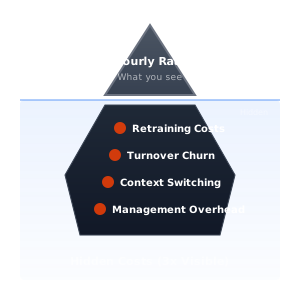
Staff Aug rates are 20-30% higher to cover churn risk. You are paying for the option to quit.
Dedicated teams get faster every sprint as they learn your domain. Staff Aug developers rotate, resetting the knowledge curve repeatedly.
Procurement is not just buying capacity. It is allocating risk.
| Dimension | Staff Augmentation | Dedicated Teams |
|---|---|---|
| Management Overhead | High (You own daily tasks) | Low (Pod Lead handles execution) |
| Turnover Risk | High (Mercenaries leave for rates) | Low (Vendor guarantees retention) |
| Knowledge Retention | Zero (Walks out the door) | High (Context stays in the Pod) |
| Cost Predictability | Variable | Stable Monthly Burn |
| Best Use Case | Short Spikes (<3 months) | Core Roadmaps (>6 months) |

When using either of these models, consider these key points:
Work ends within 12 weeks.
You need a hyper-specific skill (e.g., Blockchain) for 1 feature.
You have strong internal management bandwidth.
You value exit flexibility over efficiency.
Roadmap extends beyond 6 months.
You are scaling a core product.
Internal leadership is stretched.
You want predictable monthly burn.
Quick capacity for short sprints

3-6 Months
Dedicated Teams
The cost that never shows up on an invoice.
Every external individual you manage consumes senior engineering time. Reviews, clarifications, rework, and context setting add up. In staff augmentation models, this tax grows with scale.
Dedicated teams absorb this drag. Delivery leadership is embedded. Procurement sees it as a lower line item. Engineering feels it as breathing room. That is why, over time, dedicated teams are easier to live with.
Still have queries? Check out our FAQs to get a better understanding of our services, pricing, and expertise. If you don't find what you're looking for, feel free to reach out to us directly.
The core distinction between the two is the degree of operational management responsibility. With staff augmentation, your organization is responsible for managing the deliverable tasking directly (like renting a resource). As opposed to that, dedicated teams have a shared management relationship with the vendor being responsible for resource retention and resource flow (or the building of resources). After 12 months, this typically leads to 20 to 30 percent deviation in monthly cost.
If you have short-term projects lasting less than 12 weeks, if your project requires highly specialized talents (blockchain and artificial intelligence), or if you need maximum exit flexibility, choose staff augmentation. In these examples, it is also important to consider that your internal management may have the capacity and capability to address the 15 to 25 percent oversight drag related to staff augmentation (which does not show up in invoices).
Dedicated teams will typically become cheaper than staff augmentation within the sixth month of project delivery (18 percent) and the twelfth month (30 percent) of the project delivery. This is primarily due to knowledge compounding. According to procurement data for 2025, the crossover point for the two models of team management typically occurs within the third to fourth month for projects with total budgets exceeding $150,000.
On average, staff augmentation has a 20 to 30 percent premium for flexibility and has hidden management costs. By the way, it is typical for staff augmentation to have three times the visible management expenses for their management practice versus those of dedicated teams. While both models must meet regulatory hourly pay rates in order to be compliant with Fair Labor Standards Act regulations, dedicated teams provide up to 45 percent greater long-term efficiency than staff augmentation due to the domain knowledge they have acquired and the lower turnover rates associated with them.
Staff augmentation creates 25% to 40% of management overhead, which is not captured by invoices. In addition, those outside developers utilize the time of a senior engineer for approximately four to six hours per week for review, clarification and rework, creating an additional burden of monthly productivity loss of $800 to $1,200 per resource.
Dedicated teams increase throughput by 15% to 20% each sprint as they develop knowledge and skills related to their particular area. With staff augmentation, every time a resource rotates out of the team there is a complete reset of knowledge. Therefore dedicated teams accumulate their collective knowledge regarding their area of expertise and develop an institutional memory that provides 30% or more savings after 12 months.
Annual churn for staff augmentation results in an overall operational cost for recruiting replacements that is approximately $18,000 to $25,000 per replacement. A dedicated team typically maintains at least 85% retention, uses a five-day replacement SLA to handle unexpected departures and mitigates the risk of losing $11,200 or more each month from decreased productivity when someone leaves unexpectedly.
When comparing TCO at the end of 24 months, dedicated teams will provide at least a 40% to 55% less TCO than staff augmentation. The compounding efficiencies will result in a minimum savings of $150,000 to $300,000 for every four-developer squad as compared to rotating augmented resources.
Although the client is ultimately responsible for the management, delivery, and quality of resources utilized to deliver services when using staff augmentation, the client’s risk is shifted towards the use of Dedicated Teams, with the delivery vendor bearing the management burden (which can be up to 20% of total project cost) and providing leadership for the delivery of those services as well as guaranteeing the delivery of results rather than merely the delivery of hours worked.
To determine the crossover point on your individual projects, you will need to calculate (Monthly Management Hours X Senior Engineer Rate) + (Expected Churn X $1850000/Number of Months in Project) + (Knowledge Loss X 15% of Cost) for each month of your project’s anticipated life cycle. Most projects will begin crossing over within 3.2-4.1 months once the efficacy of a dedicated team outweighs the appearance of flexibility offered by staff augmentation.
In the United States, 68% of procurement choices are made based on incorrect engagement models (with 47% of the projects experiencing budget overruns). The most common mistake is using staff augmentation for projects longer than six months, which incurs an average additional cost of $65,000 (for management drag and churn) on the back end of the project.
This page provides market benchmarks and cost analysis. But every company's needs are different. Your specific headcount, tech stack, timeline, and region preference should drive your final budget.
Book a Roadmap Review Call. We will map your timeline against the 6, 12, and 24-month cost curves to identify the crossover point for your specific case.
Download 2026 Rate Card