

...

3 Reasons Why STEM Shortage in UK?

The STEM shortage in UK is predicted to cost economy £1.5 billion annually, endangering digital transformation, net-zero goals, and corporate expansion. 

The availability of STEM skills in the UK workforce is a source of concern. But the question is What are the main reasons for the STEM workforce shortage in the UK? What is holding back them?  

Due to a lack of skilled workers, 49% of engineering and technology companies report having trouble hiring, because youth in the UK are now more focused and involved in law and accounting related fields and that’s why STEM shortage happens.


Which Industry in the UK is most affected by the STEM talent gap? 

Although there is a widespread STEM shortage in the UK, it is particularly noticeable in industries that are leading the shift to Net Zero, undergoing rapid digital transformation, or are dedicated to large infrastructure projects. 

The businesses and sectors most impacted are listed below, along with the positions they find difficult to fill:  
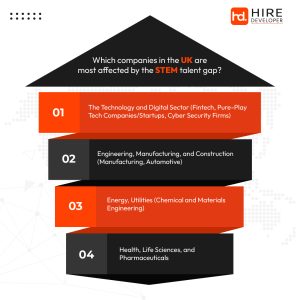
 

STEM Shortage in UK

Digital and IT 

Since the need for digital skills is now present in all industries, not just specialized IT companies, this is perhaps the most affected sector. Talent shortages, according to over 70% of UK digital leaders, are delaying business progress. 

There is a shortage of this tech talent in the UK: AI/ML Engineers, Cyber Security Analysts, Cloud Engineers, Data Scientists. 


Engineering, Manufacturing & Construction 

The UK’s traditional STEM stronghold has long-standing, chronic shortages that are frequently made worse by an aging workforce that is getting close to retirement. Due to a lack of skilled workers, almost 49% of engineering companies report having trouble hiring new employees. 


Tech talents like Civil/Design Engineers, Electrical Engineers, Specialist Technicians, Quantity Surveyors need the most. 


Energy and utility  

In energy and utility sectors like renewable energies and energy providers suffer the most.  

Talents like Renewable Technology Specialists and Power and Process Engineers’ shortage are there.  


Health, Life Sciences, and Pharmaceuticals 

Youth is not attracted, or we can say that not focused on health and science related areas, perception matters but this makes UK suffer for health field related talent shortage.  

  • Pharmaceutical and Biotech Companies: Driven by R&D, these companies need biological scientists, chemists, and specialist R&D engineers. 
  • HealthTech: Companies developing AI diagnostics, remote monitoring tools, and health data platforms. 


Education and Pipeline Issues 

Low Participation in Essential Subjects: Although the number of students enrolling in STEM fields at the university level is on the rise, the pace of this growth is insufficient to satisfy industry needs, particularly in vital sectors such as Engineering, Technology, and Physics. 


Shortage of Specialized STEM Educators: There remains a significant challenge in attracting and keeping specialized STEM educators, with recruitment goals for subjects like Maths, Physics, and Computing frequently falling short. This situation negatively impacts the quality and accessibility of advanced STEM education in schools. 


Inadequate Career Guidance and Awareness: A lot of young individuals, particularly girls, do not receive clear and high-quality career guidance regarding the diverse opportunities available in STEM fields, and they often cling to outdated perceptions about what careers in STEM entail. This lack of early exposure leads to diminished interest. 


Skill Mismatch: There is an ongoing discussion about whether the issue stems solely from a lack of individuals or from a disconnect between the skills that employers require (especially practical, job-ready skills) and those that graduates have. For instance, there are notable shortages at the technician level and in advanced digital skills such as AI and cybersecurity. 


Reasons Why STEM Shortage in UK? 


Investment in domestic pipeline (long-term goal) 

These actions are aimed at fixing a long-term, systemic problem, but provide little relief for immediate hiring needs. 

Apprenticeships and vocational training: Increased funding and focus on degree apprenticeships, T-levels and vocational subjects help to develop job-specific, technical skills from an early age. 

School and university outreach: Tech companies partner with educational institutions to inspire youth, improve career guidance and ensure curriculum content is aligned with current industry needs (e.g. digital skills, artificial intelligence and green skills). 


Workforce and Retention Challenges 

Aging Workforce and Retirement: A large segment of the seasoned STEM workforce, especially in engineering, is approaching retirement age, resulting in a diminishing pool of experienced professionals that new hires are not sufficiently replacing. 


Competition from Non-STEM Sectors: Numerous STEM graduates, particularly those with strong analytical abilities from fields like Mathematics or Physical Sciences, are discovering prestigious, higher-paying roles in non-STEM sectors (such as finance and consulting), which pulls them away from the essential STEM industries. 


Recruitment and Retention: Organizations are facing challenges in attracting and retaining qualified personnel. Nearly 90% of STEM companies have indicated difficulties in hiring over the past year, often leading to inflated salaries or recruitment from outside the UK. 


How do UK tech firms address the shortage of STEM professionals? 

Global outsourcing  

Many UK companies hire global tech talent from talent partners, manual hiring and references but if you are a company who is looking for cost effective and efficient then you must go for Remote work solutions for UK businesses, because it not only saves your costing but also seasoned developer and tec teams. 

Enhancing Compensation and Benefits 

To compete for the limited pool of domestic talent, firms must escalate their offers, which drives operational costs. 

Salary Inflation: A significant majority of employers (over 75%) are forced to offer inflated salaries to attract appropriately skilled workers, leading to higher labor costs estimated to cost the UK economy 1.5$ billion per year. 

Focus on Employee Value Proposition (EVP): Tech firms are improving non-monetary benefits like flexible working arrangements, remote options, comprehensive well-being packages, and clear ESG (Environmental, Social, Governance) strategies to appeal to modern talent. 

Upskilling, Reskilling, 

Many companies suffer due to talent shortage in the UK, which causes them 90-120 days to hire a perfect tech expert for them. The major thing they are trying is to find out How to solve the UK tech talent gap, so that they don’t need to phase talent shortage gap.  

Initiative they take is.  

Internal Reskilling Initiatives: Organizations invest in developing training programs for up-skilling existing employees to fill in-demand jobs (training a conventional developer in a new cloud technology). 

Hiring overseas tech talent UK; is now shifted and more focused towards hiring remote tech talent for their projects and some of them are Hiring Indian software engineers UK, because Indian Software developers are pocket friendly and skilled in all matter. 


What is IR35 and how does IR35 impact on UK tech talent shortage? 

The technology sector in the UK employs a number of contracted employees, but IR35 regulations have clouded tax status within some applicants, discouraging them from considering ‘inside IR35’ contracts.  


In today’s digital world, technology and innovation are increasingly being incorporated into people’s lives. Ranging from health trackers to money apps, green technology innovations to AI-powered cybersecurity solutions, innovation in technology is omnipresent and represents an increasingly important part of the UK economy. 


Which government initiatives support STEM education and employment in the UK? 


Policy Considerations 

Economic Objectives: The need for STEM skills is on the rise as the UK sets ambitious targets in fields such as Net Zero (green economy), digital transformation, and the expansion of high-tech industries like AI and robotics. Unfortunately, the availability of these skills is not keeping up with the growing demand. 


Effects of Immigration Policy Changes (e.g., Brexit): The alterations in immigration regulations and the UK’s exit from the EU have created more hurdles and increased costs for businesses looking to hire highly skilled international STEM professionals, who have traditionally been a vital component of the UK’s STEM workforce. 


Wider Economic and Policy Considerations 

Economic Objectives: The need for STEM skills is on the rise as the UK sets ambitious targets in fields such as Net Zero (green economy), digital transformation, and the expansion of high-tech industries like AI and robotics. Unfortunately, the availability of these skills is not keeping up with the growing demand.   

Effects of Immigration Policy Changes (e.g., Brexit): The alterations in immigration regulations and the UK’s exit from the EU have created more hurdles and increased costs for businesses looking to hire highly skilled international STEM professionals, who have traditionally been a vital component of the UK’s STEM workforce. 


How do UK universities collaborate with industry to reduce STEM shortages? 

Universities in the UK and industry collaborate essentially to ensure that skills demanded by industry are imparted to graduates. It’s all about bridging the gap between what is being taught and what is demanded by the industry. 

The key strategies are: 

Designing Courses Together: Businesses identify what is exactly missing in a university curriculum, down to what engineering techniques. This means what one learns is useful right away. 

Work Experience counts: They strongly emphasize degree Apprenticeship, where the students work as full-fledged employees while pursuing their degree and long-term placement opportunities in forms of internship. This will ensure their graduate employees are job-ready from their very first day at work. 

Joint Research: They collaborate for research projects (including KTPs), where graduates are employed within a company to tackle a practical business issue. The aim is to implement new knowledge within a company using high-level experts. 


Are there recruitment agencies specializing in STEM roles in the UK? 

The widespread STEM shortage in the UK is no longer a challenge that can be solved by domestic efforts alone; This is a significant project bottleneck that requires immediate, strategic action. While investment in apprenticeships and upskilling is vital in the long term, high-growth UK technology companies cannot afford project delays and rising labor costs due to the existing talent gap. 

The definitive answer lies in accessing the global talent pool, particularly India’s vast reservoir of highly skilled, specialist software and engineering professionals, who are eager to contribute to the UK’s technological growth.  

This is where HireDeveloper.dev step in. We eliminate the risk, time and complexity of recruiting internationally by providing pre-vetted, compliant and culturally integrated Indian software engineers directly to your UK teams.  

Whether you need specific expertise in AI/ML, cloud architecture, or cybersecurity, we provide proven talent to rapidly scale your operations. Stop waiting for plumbing to turn on; Take control of your growth strategy today by accessing a world-class talent pool through a trusted partner. 


How to Hire Software Developers | The Complete Guide

According to a Statista report the worldwide developer population will reach 28.7 million by 2024. It becomes more difficult for you to find a suitable developer who will work hard on the project to make the most of the fresh approach. As a global IT staffing services provider, we decided to provide this guide regarding how to hire software developers to help many people. The complete manual includes insights, methods, and best practices for hiring software developers, covering everything from initial planning to integration of the new team member.

How to Hire Software Developers

Hiring software developers is a challenging task due to the high demand and limited pool of suitable candidates. You must be ready to offer attractive wages, engaging projects, and appealing conditions for work, especially remote employment. Let’s look at the fundamental strategies for finding great software developers for your business.

  • Determine What Kind Of Developer You Want In Terms Of Skills And Qualifications
  • Create An Appropriate Description For The Position
  • Find The Requirements That Developers Are Looking For In A Job
  • Discover The Best Possible Recruiting Strategy
  • Prepare And Conduct Successful Interviews
  • Applicant Evaluation

1. Assess Technical Skills and Qualifications

When hiring the best software developers, it is essential to figure out which exact skills and qualities are essential for the job, as well as those that are advised but not required. By spending the time to do this, recruiters and hiring managers may ensure that they find the best developers for the job. Here are the key abilities and qualifications to search for:

A solid coding experience, including fluency in various programming languages, is required to meet the role’s specialised needs. For example, 1+ years of experience for junior roles, 2+ years for mid-level posts, and 5+ years for senior positions.

Solid understanding of software engineering principles and methods. Capability to create and maintain sophisticated software systems. Excellent problem-solving and analytical abilities.

Experience identifying and optimising software code, as well as a thorough understanding of developing software security challenges.

Excellent communication and interpersonal skills, as well as a welcoming personality, are required for effective integration into the development team; the ability to collaborate with colleagues and clients, as well as lead and train junior developers.

Proficiency in scripting for automating monotonous operations, optimising processes, and potentially saving time and resources.

Insight into associated technologies and languages that interact with the projects being developed, such as databases and web technologies. This is extremely useful for complex development jobs.

2. Post the Perfect Job Ad, Tailored for Recruiting Success

A well-written job description is the first step toward notifying top software developers that you have an attractive software developer opportunity to offer. A comprehensive job description that is both clear and accurate will draw the interest of prospective candidates by providing insight into their anticipated work and how it might contribute to the company’s long-term success. Our recruiters provide the finest information to applicants by detailing the role’s content, duties, location, remuneration, and expectations – this ensures they have a competitive edge.

3. What Do Developers Look for?

Say goodbye to the days when employees wanted to work for a firm because it was popular, had competitive salaries, and offered gym discounts or complimentary lunches. Developers, particularly those with advanced talents, expect much more. HackerRank’s 2019 Developer Skills Report surveyed 71,000 developers from 100 countries. The objective was to identify the primary motives of developers when looking for a job. The findings were startling because neither junior nor senior-level developers chose ‘competitive compensation’ as their first option. 

First option: Professional development and learning.

Juniors: 71.5%

Seniors: 57.9%

Second option: Work-life balance.

Juniors: 45.7%.

Seniors: 44.7%.

The third option: is competitive compensation.

Juniors: 31.3%

Seniors: 42.9%.

In short, before starting to hire, identify exactly what you will offer. Highly qualified applicants care (a lot) about having a greater balance between work and personal life, which translates to having the chance to work remotely. 

4. Discover the Best Possible Recruiting Strategy

The next step is to find ideal software developers. Social networking is the most effective recruitment tool available today. But with so many social media networks, how can you know which one is the best for looking for potential candidates? Let’s take a look at some social media recruitment data.

87% of recruiters use LinkedIn

Around 55 % of recruiters use Facebook

47% of recruiters use Twitter

Apart from social networking, there are additional effective tactics you can utilise in your search for ideal software developers. Looking for applicants is a good start, but if you have a strong internet presence and an established name, candidates may come looking for jobs with your organisation. Where can software developers find recruiters? The most significant place is a job board on your website. Make sure it is both visually appealing and up to date.

5. Crafting the Best Interviewing Procedure

You would like to hire a new software developer with specific talents, but a résumé is never enough. Simple questions like “What is your greatest weakness?” cannot be answered either. You have to look deeper and more informed. One approach to accomplish this is to break interviews into two parts: technical discussions and personality interviews.  In the IT industry, interview questions are never the same. It depends on the type of software developer you want to hire and for what purpose. If you wish to recruit a professional, you or the person conducting the interviews must be knowledgeable about the issue. You can’t ask about something you’re not familiar with. Personality interviews are equally essential. Consider employing a candidate with exceptionally hard capabilities but poor communication skills. This has major productivity ramifications that may harm your business. Make time to ask the correct questions; this will give you an idea of how this individual works and whether you want them on the team. 

6. Applicant Evaluation

Here are a few things to consider while making your selection.

Known programming languages

A candidate must be skilled in the language of the project he will be integrating, but other languages can also be used to determine which candidate is a better match. If you have a candidate who knows additional languages or frameworks that you believe will be valuable in other areas of the project or future projects, they are likely a strong fit.

Problem-solving ability

This is an important indicator to consider while conducting interviews. Technical knowledge is required, but understanding how to apply it is crucial. Creativity may also play a significant role in issue solutions and should not be underestimated.

Ancillary technology

If your project includes additional technologies such as databases, cloud services, security, and privacy, hiring developers who are knowledgeable about these subjects may assist in streamlining development and communication between departments.

Communications and Teamwork

A strong communicator will fit in better with teams and assist bridge the gap between tech-savvy and non-tech-savvy members. Also, ensure that they are culturally compatible to foster employee collaboration. In short, do not rely just on technical expertise or delivery. Sometimes a more well-rounded individual is the best choice. Being competent at technology does not ensure a strong connection with the rest of the development team. Check for good soft skills that you believe would be a more appropriate match than raw technical skills.

By following the above steps and conventional procedures, you can accelerate the hiring process and discover the appropriate software developer to help your team flourish while also encouraging creativity in your firm. Understand that recruiting is more than just selecting the best-talented candidate; it is also necessary to find a person who fits the culture of your business, beliefs, and long-term goals. Invest time and effort in the hiring process to ensure you make the best option for your team and the organisation.

Looking to grow your development team with the best talent? Look no further! Hire Developer provides highly skilled developers ready to join your team.

Hire Developer in London

Hire Developer in Miami

Hire Developer in New York

Hire Developer in San Diego

Hire Developer in Feltham

Hire Developer in Chicago

Hire Developer in Dallas 

Top Benefits of Hiring Software Developers

When you need specific software that meets your particular requirements, you should look for an experienced software developer. The internet world is wide and competitive, especially in today’s market, making it tough for businesses to succeed unless they are amazingly active and effective in attracting an expanding number of clients. And, to be the finest in the digital world, you must have an exciting and appealing website with distinctive and functional features. The simplest way to get this type of service is by hiring an experienced software developer team. When you hire software developers, you gain access to a multitude of benefits that result in excellent results as well as effective project outcomes. Here’s a summary of each of these advantages:

1. Customised Solutions

Every business faces specific needs and challenges. Hiring software developers helps you to create customised programs that fit your particular needs. Developers can offer solutions that are in line with your company’s goals and objectives, whether they are creating a mobile app, a website, or custom software.

2. Expertise in Modern Technologies

Software developers are skilled in the latest and most recent programming languages, frameworks, and tools. Hiring developers with expertise in new technology stacks gives you access to their specific knowledge, allowing your organisation to stay ahead of the competition and implement innovative strategies.

3. Faster time-to-market

In today’s competitive environment, speed is key. Software developers may speed up the development process, allowing you to get your products and services to market faster. Their experience enables rapid coding, testing, and deployment, which reduces time-to-market and gives you a competitive advantage.

4. Cost-Effectiveness

Hiring software developers may be cheaper than keeping an in-house team. With remote work becoming more common, you may tap into global talent pools and hire top-tier developers at affordable costs. Outsourcing development also avoids the overhead costs associated with employing and maintaining people.

5. Scalability and Flexibility

Your software needs will expand in tandem with your business. Hiring developers offers flexibility and adaptability, enabling you to expand the team as needed. Whether you need to speed up production during high seasons or pull down during downtime, having a dedicated team of developers helps you adjust to shifting demands.

6. Innovation and Creativity

Software developers are natural solution-seekers and innovators. By getting them on board, you provide your business with fresh perspectives and concepts. Their innovative approach to problem-solving may result in game-changing ideas that fuel growth and set your organisation apart from the competition.

Types of Models for Hiring Software Developers

If you’re unfamiliar with the employment model, don’t worry. To help you in creating multiple recruiting models, we have organised them into a single place. This can help you identify the best approach for your specific project requirements.

Dedicated Team Model

If you don’t have enough time to track the progress of your project, this model is ideal for you. The idea behind this approach allows you to recruit the top developers who will dedicate fully to your project. The skilled developers will work on your project with minimum supervision because they have extensive expertise in managing difficult projects. All you have to do is engage with the project manager regularly and the work will be completed to your specifications.

Fixed-Price Model

Under this approach, the developers will work on a budget that has been established, avoiding the possibility of additional negotiations. You only need to discuss your idea with the programmers in an understandable manner and agree on a definite price for the result. Using this approach will help you reduce risks while needing minimal management from your end. As the developer understands the value of time, they will work to accomplish the project within the estimated timetable and budget.

Hourly Pricing Model

Hiring developers on an hourly basis is useful when you have minor project requirements that can be completed in a few hours. If you already have software and need to cure codes, backup or restore it, recover from a crash, or just upgrade it with new capabilities, the hourly price model is the ideal solution. Hire remote developers based on the number of required working hours. All you have to do is share your specifications with the hired dedicated developers to assist them with the project details. You can extend the collaboration if you require additional assistance from the developers.

On-site team model

This plan of action is ideal if you want to collaborate closely with a group of programmers but do not want to hire them permanently. With this model, you may bring an entire team on-site, communicate with them one-on-one, explain your requirements, and complete the work. It will be simple for you to manage a software development team that works from your location and under your direction. Hire developers and ask that they come on-site for your project. This approach is ideal if your project requires continuous input and approvals. We looked over all of the different hiring procedures in detail, as well as how they were compared. Now, you can simply choose one of the hiring models which can help you complete the project within the estimated timetable and budget.

Hire Software Developers Today for Your Project!

This guide will provide you with the five phases to hiring an excellent software developer, as well as flexible hiring models of hiring developers. We hope this makes it easier for you to locate and hire a suitable developer who will provide the best software solution for your specific requirements. Contact us if you want to hire dedicated developer with extensive expertise working on numerous technology stacks and developing top software solutions for a variety of industries. When you contact us, we will set up a simple screening procedure so that you may quickly get your dedicated team on board.

Conclusion

Hiring a software developer is a significant investment in your organisation’s future and a multifaceted endeavour that requires careful planning, effective communication, and a commitment to continuous improvement. By adopting a proactive approach to recruitment, fostering a positive work environment, and prioritising cultural fit, you can build a cohesive team of talented developers who contribute to your organisation’s success. Remember, the hiring process is not just about finding the right skills but also about finding the right fit for your team and company culture. With diligence and perseverance, you can navigate the complexities of hiring software developers and build a high-performing team poised for success. Good luck on your hiring journey!

Seraphinite AcceleratorOptimized by Seraphinite Accelerator
Turns on site high speed to be attractive for people and search engines.