

The STEM shortage in UK is predicted to cost economy £1.5 billion annually, endangering digital transformation, net-zero goals, and corporate expansion.
The availability of STEM skills in the UK workforce is a source of concern. But the question is What are the main reasons for the STEM workforce shortage in the UK? What is holding back them?
Due to a lack of skilled workers, 49% of engineering and technology companies report having trouble hiring, because youth in the UK are now more focused and involved in law and accounting related fields and that’s why STEM shortage happens.
Which Industry in the UK is most affected by the STEM talent gap?
Although there is a widespread STEM shortage in the UK, it is particularly noticeable in industries that are leading the shift to Net Zero, undergoing rapid digital transformation, or are dedicated to large infrastructure projects.
The businesses and sectors most impacted are listed below, along with the positions they find difficult to fill:
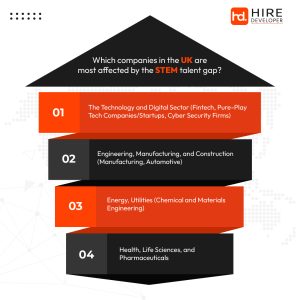
Digital and IT
Since the need for digital skills is now present in all industries, not just specialized IT companies, this is perhaps the most affected sector. Talent shortages, according to over 70% of UK digital leaders, are delaying business progress.
There is a shortage of this tech talent in the UK: AI/ML Engineers, Cyber Security Analysts, Cloud Engineers, Data Scientists.
Engineering, Manufacturing & Construction
The UK’s traditional STEM stronghold has long-standing, chronic shortages that are frequently made worse by an aging workforce that is getting close to retirement. Due to a lack of skilled workers, almost 49% of engineering companies report having trouble hiring new employees.
Tech talents like Civil/Design Engineers, Electrical Engineers, Specialist Technicians, Quantity Surveyors need the most.
Energy and utility
In energy and utility sectors like renewable energies and energy providers suffer the most.
Talents like Renewable Technology Specialists and Power and Process Engineers’ shortage are there.
Health, Life Sciences, and Pharmaceuticals
Youth is not attracted, or we can say that not focused on health and science related areas, perception matters but this makes UK suffer for health field related talent shortage.
- Pharmaceutical and Biotech Companies: Driven by R&D, these companies need biological scientists, chemists, and specialist R&D engineers.
- HealthTech: Companies developing AI diagnostics, remote monitoring tools, and health data platforms.
Education and Pipeline Issues
Low Participation in Essential Subjects: Although the number of students enrolling in STEM fields at the university level is on the rise, the pace of this growth is insufficient to satisfy industry needs, particularly in vital sectors such as Engineering, Technology, and Physics.
Shortage of Specialized STEM Educators: There remains a significant challenge in attracting and keeping specialized STEM educators, with recruitment goals for subjects like Maths, Physics, and Computing frequently falling short. This situation negatively impacts the quality and accessibility of advanced STEM education in schools.
Inadequate Career Guidance and Awareness: A lot of young individuals, particularly girls, do not receive clear and high-quality career guidance regarding the diverse opportunities available in STEM fields, and they often cling to outdated perceptions about what careers in STEM entail. This lack of early exposure leads to diminished interest.
Skill Mismatch: There is an ongoing discussion about whether the issue stems solely from a lack of individuals or from a disconnect between the skills that employers require (especially practical, job-ready skills) and those that graduates have. For instance, there are notable shortages at the technician level and in advanced digital skills such as AI and cybersecurity.
Reasons Why STEM Shortage in UK?
Investment in domestic pipeline (long-term goal)
These actions are aimed at fixing a long-term, systemic problem, but provide little relief for immediate hiring needs.
Apprenticeships and vocational training: Increased funding and focus on degree apprenticeships, T-levels and vocational subjects help to develop job-specific, technical skills from an early age.
School and university outreach: Tech companies partner with educational institutions to inspire youth, improve career guidance and ensure curriculum content is aligned with current industry needs (e.g. digital skills, artificial intelligence and green skills).
Workforce and Retention Challenges
Aging Workforce and Retirement: A large segment of the seasoned STEM workforce, especially in engineering, is approaching retirement age, resulting in a diminishing pool of experienced professionals that new hires are not sufficiently replacing.
Competition from Non-STEM Sectors: Numerous STEM graduates, particularly those with strong analytical abilities from fields like Mathematics or Physical Sciences, are discovering prestigious, higher-paying roles in non-STEM sectors (such as finance and consulting), which pulls them away from the essential STEM industries.
Recruitment and Retention: Organizations are facing challenges in attracting and retaining qualified personnel. Nearly 90% of STEM companies have indicated difficulties in hiring over the past year, often leading to inflated salaries or recruitment from outside the UK.
How do UK tech firms address the shortage of STEM professionals?
Global outsourcing
Many UK companies hire global tech talent from talent partners, manual hiring and references but if you are a company who is looking for cost effective and efficient then you must go for Remote work solutions for UK businesses, because it not only saves your costing but also seasoned developer and tec teams.
Enhancing Compensation and Benefits
To compete for the limited pool of domestic talent, firms must escalate their offers, which drives operational costs.
Salary Inflation: A significant majority of employers (over 75%) are forced to offer inflated salaries to attract appropriately skilled workers, leading to higher labor costs estimated to cost the UK economy 1.5$ billion per year.
Focus on Employee Value Proposition (EVP): Tech firms are improving non-monetary benefits like flexible working arrangements, remote options, comprehensive well-being packages, and clear ESG (Environmental, Social, Governance) strategies to appeal to modern talent.
Upskilling, Reskilling,
Many companies suffer due to talent shortage in the UK, which causes them 90-120 days to hire a perfect tech expert for them. The major thing they are trying is to find out How to solve the UK tech talent gap, so that they don’t need to phase talent shortage gap.
Initiative they take is.
Internal Reskilling Initiatives: Organizations invest in developing training programs for up-skilling existing employees to fill in-demand jobs (training a conventional developer in a new cloud technology).
Hiring overseas tech talent UK; is now shifted and more focused towards hiring remote tech talent for their projects and some of them are Hiring Indian software engineers UK, because Indian Software developers are pocket friendly and skilled in all matter.
What is IR35 and how does IR35 impact on UK tech talent shortage?
The technology sector in the UK employs a number of contracted employees, but IR35 regulations have clouded tax status within some applicants, discouraging them from considering ‘inside IR35’ contracts.
In today’s digital world, technology and innovation are increasingly being incorporated into people’s lives. Ranging from health trackers to money apps, green technology innovations to AI-powered cybersecurity solutions, innovation in technology is omnipresent and represents an increasingly important part of the UK economy.
Which government initiatives support STEM education and employment in the UK?
Policy Considerations
Economic Objectives: The need for STEM skills is on the rise as the UK sets ambitious targets in fields such as Net Zero (green economy), digital transformation, and the expansion of high-tech industries like AI and robotics. Unfortunately, the availability of these skills is not keeping up with the growing demand.
Effects of Immigration Policy Changes (e.g., Brexit): The alterations in immigration regulations and the UK’s exit from the EU have created more hurdles and increased costs for businesses looking to hire highly skilled international STEM professionals, who have traditionally been a vital component of the UK’s STEM workforce.
Wider Economic and Policy Considerations
Economic Objectives: The need for STEM skills is on the rise as the UK sets ambitious targets in fields such as Net Zero (green economy), digital transformation, and the expansion of high-tech industries like AI and robotics. Unfortunately, the availability of these skills is not keeping up with the growing demand.
Effects of Immigration Policy Changes (e.g., Brexit): The alterations in immigration regulations and the UK’s exit from the EU have created more hurdles and increased costs for businesses looking to hire highly skilled international STEM professionals, who have traditionally been a vital component of the UK’s STEM workforce.
How do UK universities collaborate with industry to reduce STEM shortages?
Universities in the UK and industry collaborate essentially to ensure that skills demanded by industry are imparted to graduates. It’s all about bridging the gap between what is being taught and what is demanded by the industry.
The key strategies are:
Designing Courses Together: Businesses identify what is exactly missing in a university curriculum, down to what engineering techniques. This means what one learns is useful right away.
Work Experience counts: They strongly emphasize degree Apprenticeship, where the students work as full-fledged employees while pursuing their degree and long-term placement opportunities in forms of internship. This will ensure their graduate employees are job-ready from their very first day at work.
Joint Research: They collaborate for research projects (including KTPs), where graduates are employed within a company to tackle a practical business issue. The aim is to implement new knowledge within a company using high-level experts.
Are there recruitment agencies specializing in STEM roles in the UK?
The widespread STEM shortage in the UK is no longer a challenge that can be solved by domestic efforts alone; This is a significant project bottleneck that requires immediate, strategic action. While investment in apprenticeships and upskilling is vital in the long term, high-growth UK technology companies cannot afford project delays and rising labor costs due to the existing talent gap.
The definitive answer lies in accessing the global talent pool, particularly India’s vast reservoir of highly skilled, specialist software and engineering professionals, who are eager to contribute to the UK’s technological growth.
This is where HireDeveloper.dev step in. We eliminate the risk, time and complexity of recruiting internationally by providing pre-vetted, compliant and culturally integrated Indian software engineers directly to your UK teams.
Whether you need specific expertise in AI/ML, cloud architecture, or cybersecurity, we provide proven talent to rapidly scale your operations. Stop waiting for plumbing to turn on; Take control of your growth strategy today by accessing a world-class talent pool through a trusted partner.